
Anyword Alternatives: 6 AI Tools for SEO-Focused Teams
 Machined Content TeamReviewed by Nick Wallace
Anyword is built to answer a very specific question: which version of this copy is most likely to perform? For ads, landing pages, and campaign-driven content, that focus is a strength. The platform excels at helping teams choose phrasing, tone, and variations with confidence, especially when conversion metrics matter more than long-term visibility.
SEO teams, however, tend to ask a different set of questions. They care less about which sentence converts and more about whether a page deserves to rank at all. Coverage depth, intent alignment, internal structure, and how content reinforces the rest of the site matters more than micro-optimizations at the line level. When those priorities take over, Anyword can start to feel adjacent to the work rather than central to it.
Quick Summary: Looking for Anyword alternatives? Rytr favors low-cost, fast generation over predictive copy. HyperWrite suits writers who want hands-on control instead of scoring. Clearscope fits teams optimizing SEO coverage after writing. Copy.ai prioritizes workflow consolidation over search depth. Machined replaces copy optimization with topic-level SEO execution. Jasper makes sense when brand governance matters more than rankings.
That's when teams begin exploring alternatives. Not because Anyword stops working, but because SEO success requires tools that operate at a different layer of the workflow. The platforms we compared here approach the problem of search visibility from angles Anyword doesn't emphasize, focusing on research-first planning, structured drafting, consolidated SEO systems, or topic-level execution based on where teams feel the most friction.
When Anyword Stops Being Enough
Anyword excels at optimizing copy at the message level. It helps teams choose wording, tone, and framing based on predicted performance, which works well for ads, landing pages, and campaign-driven content. But SEO outcomes depend less on phrasing and more on coverage, intent alignment, and how pages relate to one another across a site.
The earliest strain usually shows up in coverage. The writing sounds polished, but pages struggle to address a topic comprehensively enough to compete with entrenched results. Teams start bolting on additional sections, references, and framing by hand, and the efficiency that made Anyword appealing begins to slip away.
Planning pressure follows quickly. Decisions about how pages relate to one another, which terms deserve dedicated coverage, and where authority should concentrate are left unresolved inside the tool. Strategy work drifts outward into documents, external research platforms, and manual coordination, fragmenting what was once a streamlined workflow.
Eventually, volume stops translating into progress. More pages go live, but they operate independently, without reinforcing one another. In the absence of intentional clustering, intent separation, or structured internal linking, effort scales faster than results.
None of this represents a flaw in Anyword's design. The platform's goal is to optimize messaging, not create search systems. The alternatives here exist because teams reach different inflection points as SEO programs mature, and once those thresholds appear, tools focused on copy performance give way to platforms built around research depth, structural clarity, or topic-level execution.
Direct Alternatives for SEO-Aligned Writing
Same core job, different tradeoffs
These tools appeal to teams that still want Anyword-style drafting speed, but need stronger alignment with search intent, structure, or SERP context rather than predictive copy scoring alone.
Rytr
Rytr appeals to teams that want simplicity and affordability without committing to a marketing-first platform. It generates readable long-form content quickly and supports basic SEO modes, which makes it useful for early-stage publishing or low-competition niches. The experience favors speed and accessibility over depth.
Low-Cost Entry Pricing
Pricing starts low and includes generous word allowances, which keeps monthly costs predictable. However, Rytr includes no meaningful research, clustering, or internal linking features. Teams save on subscription fees but spend more time compensating for missing strategy layers. Over time, that hidden effort often outweighs the initial cost advantage for SEO-driven workflows.
Rytr Pricing Tiers
- Free with feature limits
- Unlimited: $9/mo
- Premium: $29/mo
Anyword vs. Rytr
Compared with Anyword, Rytr removes predictive scoring in favor of raw generation speed. Teams usually switch when cost sensitivity outweighs the need for performance modeling or conversion-oriented guidance. The tradeoff is less strategic signal per page, which shifts responsibility back to editors to decide what deserves depth and emphasis.
Testing Takeaways from Hands-On Use
Testing showed that Rytr produces readable drafts very quickly, which reinforces its value as a low-friction writing tool. The prose flowed cleanly and avoided obvious grammatical issues, but the structure followed a generic pattern that did not adapt meaningfully to the topic. Headings tended to stay high level, and keyword coverage clustered around obvious terms rather than addressing supporting questions or adjacent intents.
To make the drafts competitive in search, we had to manually expand sections, add missing subtopics, and reshape the outline to better match ranking pages. That extra work shifted the burden of strategy and differentiation entirely onto the user. In practice, Rytr functioned well as a baseline generator for getting words on the page, but it did not provide the structural or strategic signals needed to operate as a competitive SEO system on its own.
Pros
- Very affordable entry point for budget-conscious teams
- Fast, simple generation with minimal setup
Cons
- Limited SEO depth beyond basic keyword use
- No strategy, clustering, or internal linking support
Best for: Early-stage sites establishing basic coverage on a tight budget.
HyperWrite
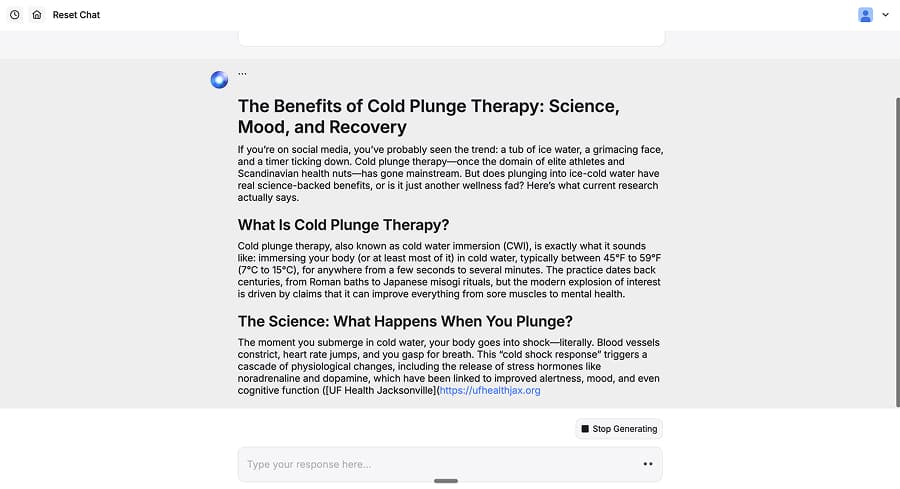
HyperWrite attracts users who want a fundamentally different writing experience from Anyword. Instead of predicting which copy performs best, it acts as a real-time co-writer, offering sentence-level suggestions, rewrites, and contextual assistance as the draft takes shape.
Control stays with the writer rather than the system, which appeals to teams that want to guide tone and direction moment by moment. The tradeoff is less built-in structure for SEO planning, making HyperWrite better suited to hands-on drafting than systematic search execution.
Session-Based Pricing for Assisted Writing
Pricing scales with access to research agents and automation features rather than output volume or SEO deliverables. Costs rise as teams unlock higher-tier assistance, even though content planning, clustering, and execution remain outside the pricing model. This makes HyperWrite's spend easier to predict for individual writers, but harder to justify as a cost-efficient SEO production tool.
HyperWrite Pricing Tiers
- Premium: $19.99/mo
- Ultra: $44.99/mo
Anyword vs. HyperWrite
Compared with Anyword, HyperWrite replaces predictive guidance with hands-on authorship. Teams switch when Anyword feels prescriptive and they want more agency during drafting, even if that slows production. The shift reflects a preference for shaping language in real time rather than choosing between scored variations after the fact. For writers who value control over efficiency, that tradeoff feels intentional rather than limiting.
Testing Takeaways from Hands-On Use
Hands-on use showed that HyperWrite excels as a writing companion rather than a production engine. Sentence-level suggestions, rewrites, and contextual prompts made it easy to improve clarity and flow while drafting, and the tool responded well to stylistic adjustments mid-session. For writers who prefer to stay closely involved in shaping language, the experience felt supportive and flexible rather than directive.
However, that strength did not translate into SEO readiness. Long-form drafts required substantial manual work to establish competitive structure, expand topical coverage, and align headings with search intent. There were no built-in signals for clustering, internal linking, or coverage gaps, which meant editors had to supply strategy entirely outside the tool. In practice, HyperWrite supported individual writers effectively, but it did not scale SEO execution beyond the page level.
Pros
- Strong real-time writing assistance during drafting
- High editorial control at the sentence and paragraph level
Cons
- Slow for bulk SEO or high-volume publishing
- No strategic planning, clustering, or execution support
Best for: Writers who want hands-on control over individual pieces.
A Research- and Optimization-First Alternative
When coverage matters more than copy
This category suits teams that already write well but switch when rankings stall and the real problem turns out to be missing topics, shallow coverage, or misalignment with what competitive pages include.
Clearscope
Clearscope focuses primarily on optimizing content rather than generating it. The platform analyzes SERPs, identifies topical gaps, and grades drafts against competitive benchmarks. While Clearscope has added a writing assistant feature, it functions more as an editorial aid than a standalone content generator. Teams use it mainly to refine coverage and relevance, with the writing assistance serving as a secondary capability rather than a core function.
Pricing as an Optimization Layer
Pricing starts at a premium monthly rate and scales with usage tied to tracked topics, reports, and monitored pages. While Clearscope includes a writing assistant, it's positioned as a secondary feature rather than a primary content generation tool, meaning teams focused on volume often still pair it with dedicated writing platforms. The pricing reflects Clearscope's role as a specialized optimization layer.
Clearscope Pricing Tiers
- Essentials: $129/mo
- Business: $399/mo
- Enterprise: Custom
Anyword vs. Clearscope
Compared with Anyword, Clearscope shifts the center of gravity from copy performance to topical completeness. Rather than predicting which phrasing is likely to convert, it evaluates whether a page covers the subjects, terms, and subtopics that competitive results already include.
Teams usually make the switch when rankings stall despite polished writing, and the problem turns out to be coverage gaps rather than messaging. While Clearscope includes AI-assisted drafting, it delivers the most value when content is created elsewhere and then analyzed to identify where depth, relevance, or structure underperforms in search.
Testing Takeaways from Hands-On Use
Clearscope delivered clear, actionable recommendations that made it easy to see where drafts lacked coverage compared with top-ranking pages. Topic terms, subtopics, and suggested inclusions aligned closely with what was already performing in search, and the grading system helped prioritize which gaps mattered most. Applying these recommendations often improved structural completeness and semantic relevance without forcing unnatural keyword usage.
At the same time, Clearscope functioned primarily as an evaluation layer rather than a production system. While the platform includes a writing assistant, it serves as a secondary feature rather than a core content generator. In practice, it worked best as a diagnostic and refinement step within a broader workflow, excelling at optimization while offering light writing assistance along the way.
Pros
- Detailed topical gap analysis and grading against competitive benchmarks
- Recommendations improve coverage without encouraging keyword stuffing
Cons
- Writing assistant is a secondary feature, not a full content generator
- Premium pricing for an optimization-focused platform
Best for: Teams that need to strengthen coverage and relevance after writing, not during it.
A Broader SEO Platform Built for Consolidation
When tool sprawl becomes the bottleneck
This option attracts teams switching away from Anyword because managing separate tools for research, auditing, tracking, and content has become inefficient, even if that consolidation comes at the cost of speed or simplicity.
Copy.ai
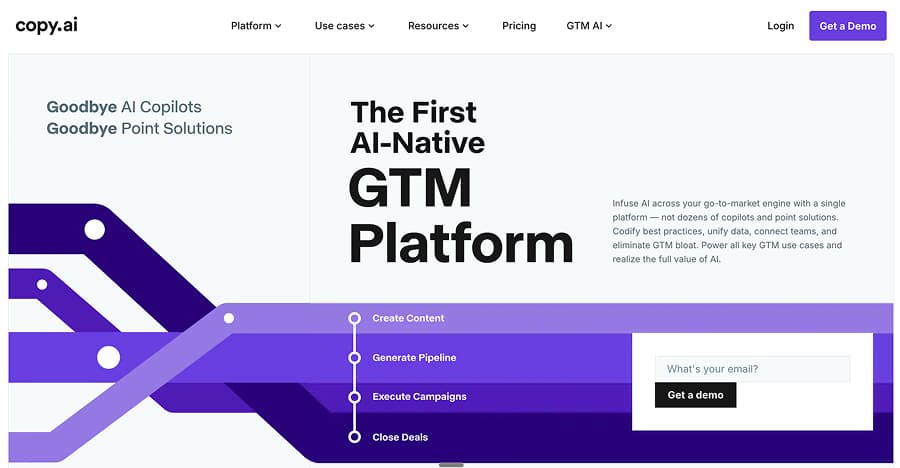
Copy.ai expands beyond copy into workflows, automation, and go-to-market content. SEO exists as a use case, but not the organizing principle. Teams use it to generate many asset types quickly from a single system, including sales enablement, lifecycle messaging, and campaign content. That breadth makes it useful for marketing operations, but it also means SEO-specific depth takes a back seat to speed and versatility.
Workflow Credit-based Pricing
Pricing is structured around subscription tiers that allocate a fixed number of workflow credits each month. As automation depth and parallel workflows increase, monthly costs rise accordingly, with SEO content drawing from the same shared credit pool as ads, emails, and other asset types. For teams considering a switch, this means search output competes directly with broader marketing use cases, making SEO-heavy workflows more expensive as volume grows.
Copy.ai Pricing Tiers
- Chat: $29/mo
- Enterprise: Custom
Anyword vs. Copy.ai
Compared with Anyword, Copy.ai trades predictive scoring for workflow consolidation. Instead of evaluating which messages are most likely to perform, it focuses on helping teams produce and coordinate a range of content types from a single system.
Teams usually make the move to Copy.ai when tool sprawl becomes the bigger problem, and speed across campaigns matters more than SEO-specific depth. In that scenario, consolidation outweighs the loss of conversion modeling or search-focused strategy.
Testing Takeaways from Hands-On Use
In hands-on testing, Copy.ai produced content quickly across a wide range of formats, and its workflow builder made it easy to spin up repeatable jobs without much setup. Generating multiple variations, repurposing messaging, and moving between asset types felt smooth and efficient. For marketing teams juggling campaigns, emails, landing pages, and social content, that speed translated into real operational gains.
Where the platform fell short was depth for search. SEO guidance remained surface-level, with limited support for intent separation, topical coverage, or structural optimization. Drafts often required external research and additional tooling to compete in search results. In practice, Copy.ai accelerated marketing output far more than it supported long-term search authority, making it better suited for breadth of production than SEO-driven growth.
Pros
- Broad automation across many marketing asset types
- Flexible templates that support varied workflows
Cons
- SEO remains secondary to general marketing use cases
- Strategy and structure still require manual planning
Best for: Marketing teams producing mixed content.
A Content System Built for Scale and Authority
When individual pages stop being the strategy
This category fits teams that move on once SEO success depends less on optimizing single articles and more on building coordinated topic coverage, internal linking, and authority that compounds across a site.
Machined
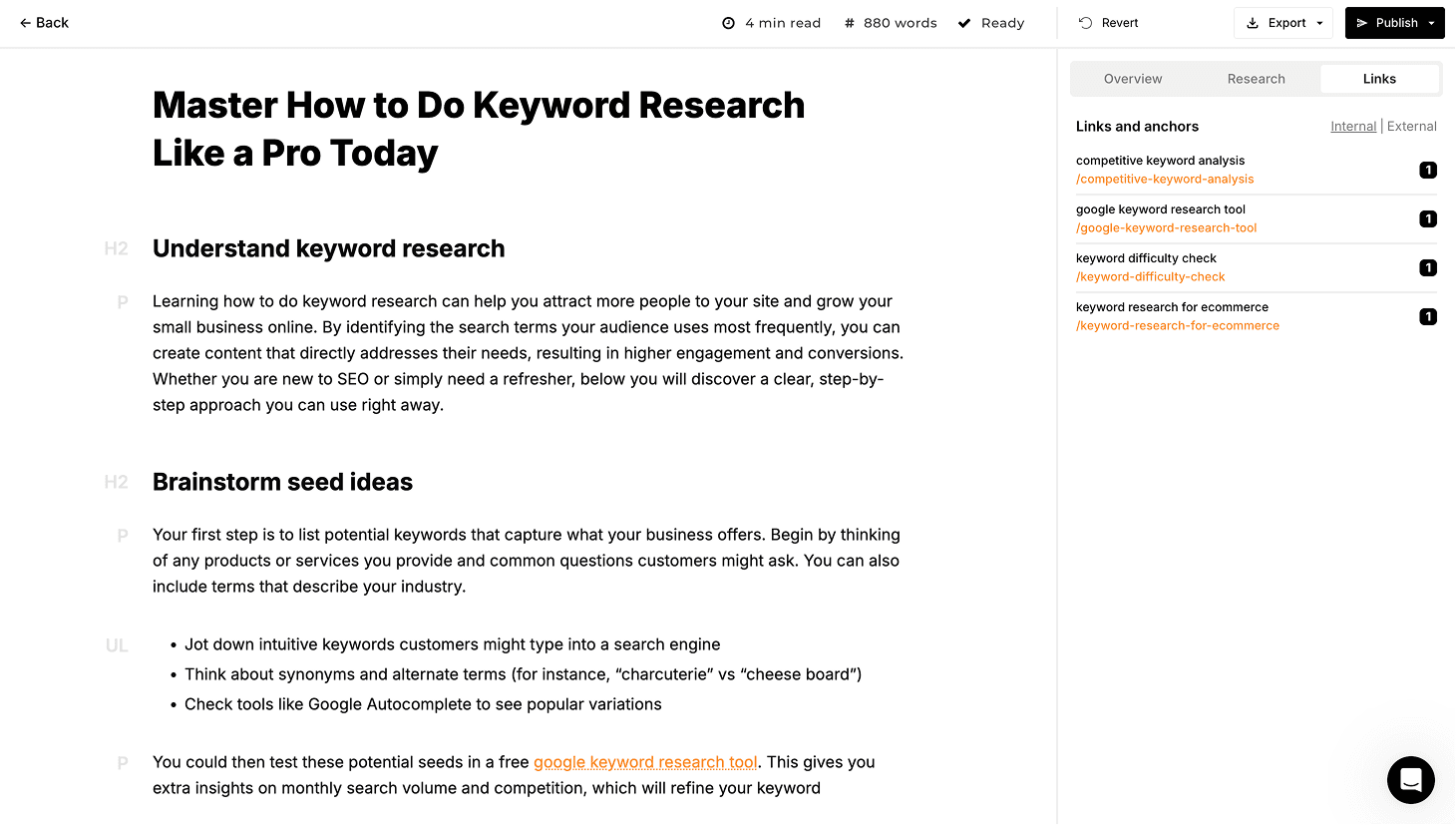
Machined approaches SEO execution at the topic level rather than the page level. Instead of optimizing individual articles, it plans and executes interconnected content systems built around search intent and coverage depth. Keyword research, clustering, article generation, internal linking, and CMS publishing operate as a single pipeline.
Each article is assigned a defined role within the cluster (pillar, supporting, or long-tail), reducing overlap and reinforcing relationships through automated internal linking. Supporting pieces strengthen pillar content instead of competing with it. This keeps clusters focused as they grow.
Usage-Driven Pricing for Scaled SEO Execution
Machined includes AI generation in its subscription, so there's no API key to manage. Paid plans at $19, $49, $99, and $249 per month unlock rising article volumes, team seats, brand voice controls, and CMS publishing to WordPress or Webflow. Because generation is bundled in, the all-in cost per article falls as you move up the tiers, from $0.63 on Launch to $0.33 on Scale. Teams publishing beyond that can switch to the BYOK plan and route generation costs directly through their own API key instead, which avoids per-article markups entirely.
Machined Pricing Tiers
- Launch: $19/mo — 30 articles ($0.63/article)
- Growth: $49/mo — 100 articles ($0.49/article)
- Pro: $99/mo — 250 articles ($0.40/article)
- Scale: $249/mo — 750 articles ($0.33/article)
- BYOK: $99/mo — 2,000 articles, plus your own API costs (~$0.20/article on average)
Anyword vs. Machined
Anyword answers how to write a single page effectively by focusing on phrasing, tone, and predictive performance signals. Machined approaches the problem at a higher level, answering how an entire site competes for a subject through coverage depth, intent separation, and internal structure.
Instead of optimizing individual messages, Machined organizes content so each page plays a defined role within a larger system. Teams tend to choose Machined when rankings hinge less on copy refinement and more on building authority through coordinated clusters, internal linking, and sustained topical ownership.
Testing Takeaways from Hands-On Use
In testing, cluster generation performed reliably end to end. Defining a topic produced a clear pillar and supporting articles targeting distinct intents rather than overlapping keywords. Internal links appeared naturally within the content using relevant anchor text, and publishing to the CMS preserved structure, links, and metadata without manual cleanup. The BYOK model kept costs predictable as volume increased, with generation and research running through direct API usage rather than triggering plan changes or hard limits.
That said, results were not entirely hands-off. Generated articles varied in quality depending on the AI model selected and the specificity of input prompts, and some pieces needed tightening for tone, accuracy, or depth before they were ready to publish. The platform handles the structural and strategic layers well, but an editorial pass remains part of the workflow rather than optional. Teams comfortable with that review step will get strong results; teams expecting fully finished output from every run will need to adjust expectations.
Pros
- End-to-end clustering, internal linking, and CMS publishing in a single workflow
- Transparent, usage-based costs that scale without caps or markups
Cons
- Focused strictly on SEO content; not suited for ads, email, or broader marketing copy
- BYOK model requires managing an external API key, which some teams prefer to avoid in favor of all-in-one pricing
Best for: Agencies and publishers building topical authority.
Enterprise and Autopilot Options
When governance or hands-off execution takes priority
This path makes sense for organizations switching away from Anyword not to improve SEO depth, but to gain brand control, approvals, or automated publishing when scale, consistency, or minimal involvement outweighs editorial flexibility.
Jasper
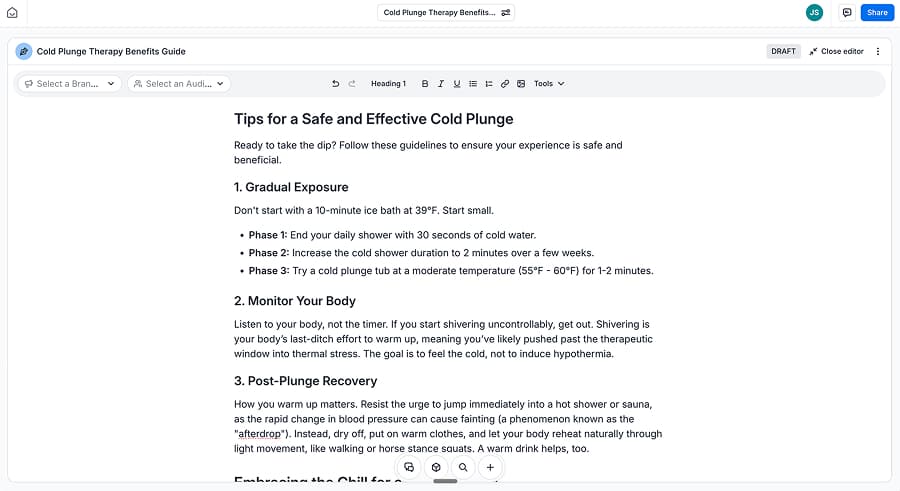
Jasper targets large organizations that need brand governance and collaboration across teams. SEO content exists within that ecosystem, but brand consistency drives feature decisions. The platform emphasizes approvals, tone control, and cross-channel alignment. As a result, it serves coordinated marketing operations better than SEO programs focused on ranking speed or topical authority.
Seat-Based Pricing for Enterprise Teams
Pricing follows a per-seat model rather than usage or output volume. Full access to the platform's governance, workflow, and collaboration features sits behind higher-level plans, which shifts cost upward as teams expand. Expenses scale with headcount instead of content production, making the platform a fixed operational investment. That structure aligns with organizations prioritizing coordination and consistency, but it offers less flexibility for SEO programs where results depend on publishing volume.
Jasper Pricing Tiers
- Pro: $69/seat/month
- Business: Custom
Anyword vs. Jasper
Compared with Anyword, Jasper replaces predictive copy guidance with organizational control and coordination. Instead of optimizing individual messages for performance, it prioritizes approvals, brand consistency, and collaboration across contributors. Teams usually make this switch when managing people, permissions, and consistency becomes more important than generating fast, testable copy.
Testing Takeaways from Hands-On Use
In hands-on use, Jasper's content quality stayed consistently high from a readability and tone perspective. Drafts followed brand direction well, avoided obvious templating, and required minimal surface edits before review. For teams producing content across multiple channels, that level of polish reduced revision cycles and simplified collaboration, especially when several contributors worked on the same assets.
Where the platform underperformed was search depth. SEO-specific guidance around intent separation, topical coverage, and structural competitiveness remained limited compared with specialized tools. Drafts often needed external research, optimization, or restructuring to compete in organic search. In practice, Jasper functioned best as a brand system that protects consistency and coordination, rather than as a ranking engine built to drive search authority.
Pros
- Strong brand controls and tone governance across teams
- Collaboration features built for large, multi-user organizations
Cons
- High cost relative to SEO-focused alternatives
- Limited SEO depth compared with specialized search tools
Best for: Enterprise marketing teams managing brand consistency, approvals, and collaboration across multiple channels.
Comparison Chart
| Tool | Pricing | Best Feature | Weakest Point | Primary SEO Use Case |
|---|---|---|---|---|
| Anyword | $49–$99/mo | Predictive copy performance | Limited SEO strategy and structure | Conversion-focused copy |
| Rytr | $9–$29/mo | Affordable, fast generation | Minimal SEO depth or planning | Budget baseline content |
| HyperWrite | $19–$44/mo | Real-time writing assistance | Poor scalability for SEO | Hands-on drafting |
| Clearscope | $129+/mo | Content optimization | Writing assistant is secondary | Search refinement |
| Copy.ai | Chat: $29/mo / Enterprise: Custom | Broad automation | SEO is secondary | Workflow consolidation |
| Machined | $19–$249/mo | Topic-level execution | SEO-only focus | Authority building |
| Jasper | $69+/seat | Brand governance | High relative cost, limited SEO | Enterprise teams |
Pricing as of February 2026. Many tools offer discounts for annual billing.
TL;DR
Closest like-for-like Anyword replacement: Rytr. It replaces predictive scoring with fast, affordable generation for teams prioritizing speed over depth.
Best for research-first workflows: Clearscope. It improves SEO outcomes by strengthening coverage and relevance rather than generating copy.
Best for consolidating your tool stack: Copy.ai. It reduces tool sprawl by combining workflows, even if SEO depth becomes secondary.
Best for building topical authority: Machined. It executes SEO strategy at the topic level through clustering, linking, and publishing.
Best tool to pair with Anyword: Machined. It handles structure and authority while Anyword continues optimizing copy.
Bottom Line: Anyword excels at optimizing copy, but SEO success increasingly depends on structure, coverage, and execution beyond messaging. The right alternative depends on where your workflow feels constrained, whether that's drafting depth, research alignment, consolidation, or authority building. In many cases, teams do not replace Anyword outright, but pair it with a tool designed to handle what comes next.
About the Authors

Machined Content Team
AuthorOur content team combines detailed research and industry knowledge to create comprehensive, unbiased, and useful articles for anyone ranging from small business and startup owners to SEO agencies and content marketers.
Nick Wallace
ReviewerLong time SEO professional with experience across content writing, in-house SEO, consulting, technical SEO, and affiliate content since 2016. Nick reviews all content to ensure accuracy and practical value.