Alternatives
Top Alternatives to Writesonic: High-Quality, SEO-Ready Content
Writesonic alternatives for generating AI content. Learn which tool best fits your needs.
· Machined.ai Content Team · updated 2026-10-12
Since the arrival of AI writing tools built specifically to help businesses with their content marketing strategies, several names have risen to the top to become big players in the industry.
One of these names is Writesonic, a highly-effective writing tool that first appeared in 2020 and has gone on to become an integral resource for hundreds of businesses looking to create human-centric articles and blogs.

It specializes in SEO-rich content designed to rank highly within search queries.
And its comprehensive research capabilities, backed by LLMs such as ChatGPT, are noted for being impressive.
However, the AI writing tool landscape is competitive, with new and innovative platforms coming to the market every year.
Some are being developed to target specific types of content, or particular areas of the creation journey such as workflow, pricing, or brand voice consistency.
So what are these alternatives?
In this article, we will attempt to answer this question. We’ll take a look at some of the best AI writing tools currently available that may suit your individual needs more closely than Writesonic.
We’ll explore the strengths and limitations of each name, and provide a comprehensive overview of where each tool might be the most suitable.
Quick Summary: Looking for Writesonic alternatives? Machined.ai leads for SEO content clustering ($19-$249/mo), Jasper excels at multi-channel marketing ($49+/mo), and Rytr offers budget-friendly options ($7.50/mo). Choose based on your content goals: SEO authority, marketing variety, or cost efficiency.
What is an AI Writing Tool?
An AI writing tool is an application or program that uses artificial intelligence and Natural Language Processing (NLP) to complete various writing tasks.
They are used for both personal and professional tasks, though in a business context, they are most commonly tasked with content generation and editorial assistance.
While there is certainly overlap between the features and tasks that an AI writing tool is capable of, they can broadly be grouped into four main types:
- Content generators: These are tools used to create business-friendly blogs, articles, and posts designed for consistent uploads.
- Grammar checkers: While these features are included in most modern AI tools, some have been specifically built to tighten external pieces of writing in terms of grammar, punctuation, syntax etc.
- SEO-focus: Some tools prioritize keyword generation, content briefs and article structure, allowing posts to rank highly in search engine queries.
- Creative writing: There are also tools to help with more creative projects, focusing more on things such as plot development and consistency, and idea generation.
For the purposes of this article, we will be focusing mainly on content generators.
How to Choose the Best Writesonic Alternative
As mentioned, there are dozens of AI writing tools now available, with many offering broadly similar features. This can make it difficult to determine which is the best for your circumstances.
And while AI tools aren’t often the most expensive business outlay, it’s obviously better to avoid wasting money on sub-standard products and getting it right the first time.
So what should you be looking out for?
What follows are some things to think about when making your choice.
Know Your Main Content Goals
Before making any decision, you should first have a clear understanding of why you want to invest in an AI writing tool in the first place.
Each application brings something a little different, so you want to make sure its strengths align with your objectives.
For example, you may wish to prioritize a product that can produce deeper, more focused content clusters and pillar posts rather than high volumes of content.
You might want something to help you develop a consistent brand voice across all forms of marketing (posts, emails, social media etc.). Or perhaps you need a one-off piece rather than consistent posts that help to demonstrate topical authority.
Whatever your goal, always keep it in mind as you explore the options available.
Before comparing features or pricing, define your main content goal. The right AI tool should support your strategy, not dictate it.
Compare Key Features
Once you know what you’re looking for in an AI writing tool, compare some of the key features within a selection of applications that make these objectives possible.
For example, if your objective is enhanced SEO performance, look out for whether your potential tools offer things such as keyword research, internal linking suggestions, and Search Engine Results Page (SERP) analysis.
This is where you’ll come to understand whether the applications target a very specific area or niche of AI writing, or whether the tool is more general.
Look for Authentic Reviews
Often the best way to research potential products is to see what other people have already said about them.
Many AI tools will have customer testimonials on their websites, and some of the more well-established might have a section of clients that they’ve worked with.
This should be treated with a caveat; naturally, all tools are going to present themselves in the best possible light on their own websites.
So be on the lookout for positive reviews from external sites as well.
Stick to Your Budget
Most AI writing tools come with a cost, and those that are offered for free often lack the necessary extra features or storage that make an AI application worthwhile.
As with most things, some tools are more expensive than others, so make sure you have a clear picture of how much you’re willing to spend on this tool.
This should also align with your goals and objectives; if your plan is to create a long-term content strategy, then look out for subscription services and what they offer.
If your approach is likely to be more sporadic, consider a pay-as-you-go model.
Top Writesonic Alternatives for 2026
Now that you know what you should be looking out for, let’s dive into what we believe are the best Writesonic alternatives currently on the market.
You can check out the table below for a comprehensive overview of what’s on offer, before taking a look at our more in-depth breakdowns for those that catch your attention.
| Tool | Content types | Stand-out features | Pricing | Ideal for |
|---|---|---|---|---|
| Machined.ai | Pillars posts, cluster content, deep SEO | Automated linking and research, SERP analysis, featured images | 7-day free trial. $19-$249/mo, generation included | SEO agencies, businesses focused on site authority |
| Scalenut | Long-form SEO articles, GEO content creation | Cruise-mode, multiple templates, adjustable brand voice | Free plan. Prices range from $37/mo - $145/mo | SEO prioritization |
| Frase | Data-backed content briefs, SEO copywriting | Community templates, real-time SEO scoring, topic clustering | No free plan. Prices range from $49/mo - $299/mo | SEO experts and content strategists |
| Jasper | Blog articles, product pages, social media posts | 50+ templates, Commands, Surfer SEO integration | Only one paid tier ($59/mo) plus custom Enterprise | All-round content strategies |
| Copy.ai | Articles, ad copy, email newsletters | Strong integration (Slack, Salesforce), Freestyle tool, Workflow Automation | Self-serve: $29/mo, Enterprise: Custom | Small businesses for quick, simple copy |
| Rytr | Blog posts, product descriptions, image content | Multi-channel promotion, creativity customization | Very affordable. Free plan available. $24.16/mo for premium. | Freelancers, small-budget businesses |
| Anyword | Social media posts, emails, short-form articles | Real-time feedback, A/B testing, performance prediction | Free plan. Prices range from $49/mo - $99/mo plus enterprise pricing. | Performance marketers and analysts, small businesses |
| Simplified | Long- and short-form content, multimedia creation | Rewriter tool, video creation, 80+ content templates | Free plan. Prices range from $12/mo - $79/mo | Businesses with multi-channel marketing approaches |
| WordHero | Short-form content | Unlimited word count, strong multilingual capabilities | No free plan. Prices range from $29/mo - $79/mo | Businesses looking for high-volume content output |
| BrandWell | High-volume SEO articles, technical content | Single-prompt long-form content, advanced humanization | Free tools available. Expensive with cheapest plan at $249/mo. | Enterprise businesses, technical fields |
Machined.ai
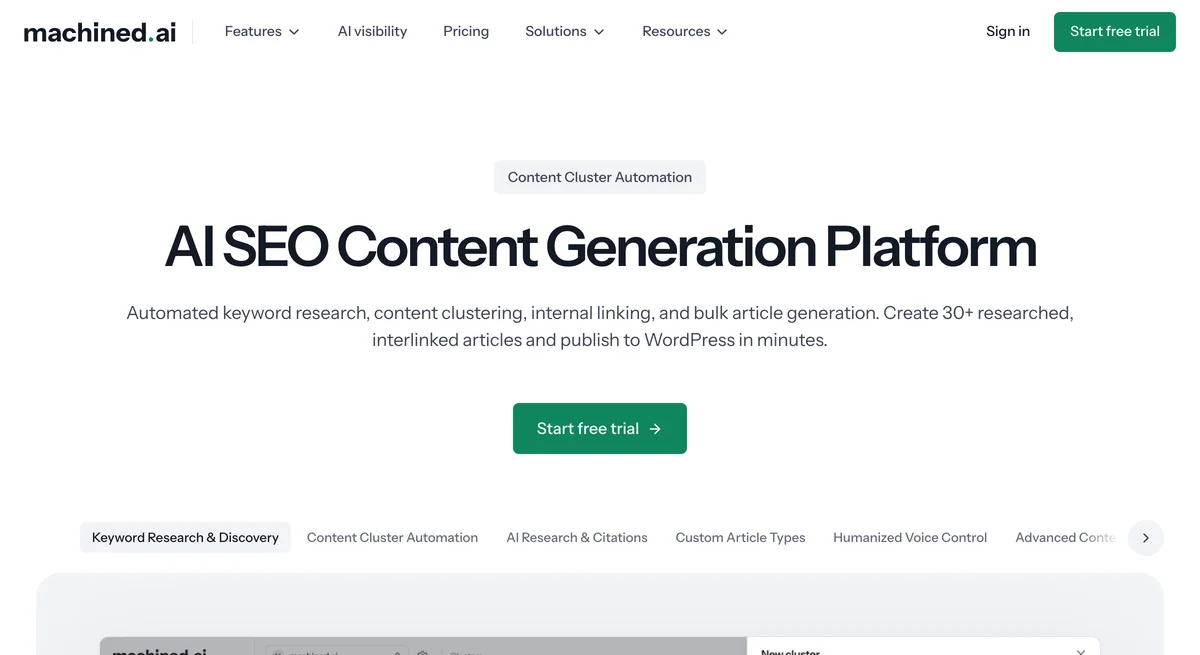
Machined.ai is a highly-intuitive platform built to deliver automated content clustering, with emphasis on high-ranking SEO performance.
It offers end-to-end automated workflows that deliver optimized content complete with interlinking and citations.
The platform provides integration with external applications including Zapier and Make, as well as featured image generation to give each article polish and authority.
Machined.ai offers a 7-day free trial plus four tiered pricing plans starting from $19/mo, and a BYOK plan at $99/mo for high-volume publishing.
Paid plans work with an OpenAI Platform account and if you don’t have one, they will guide you through the setup process.
For a detailed comparison of how Machined.ai stacks up against Writesonic, check out our Machined.ai vs Writesonic guide.
Pros
- Advanced cluster content creation
- End-to-end automation
- Scalable pricing model
- Smooth integration
Cons
- Relatively new to market
- Limited content clusters on lower-tier plans
Scalenut

Scalenut is another AI writing tool that places a great deal of emphasis on SEO performance. It’s also one of the only applications currently prioritizing GEO tools and functionality.
It offers a wide range of features specifically designed to place content produced via Scalenut as a source of authority for Large Language Models (LLMs), such as ChatGPT, to reference.
There is also an option to work with Scalenut experts who will run GEO strategies for you, giving you the opportunity to focus on other areas of your business.
Its Cruise Mode offers the chance to create long-form content from a single keyword and title.
Its functionality is divided into two main suites - AI Writing and SEO Research, which can make workflows a little less streamlined at times. For more details, see our Scalenut alternatives guide.
Pros
- Advanced GEO functionality
- Excellent support
- High-level analytics
Cons
- Steep learning curve for new businesses
- Cruise Mode can require considerable editing
Frase
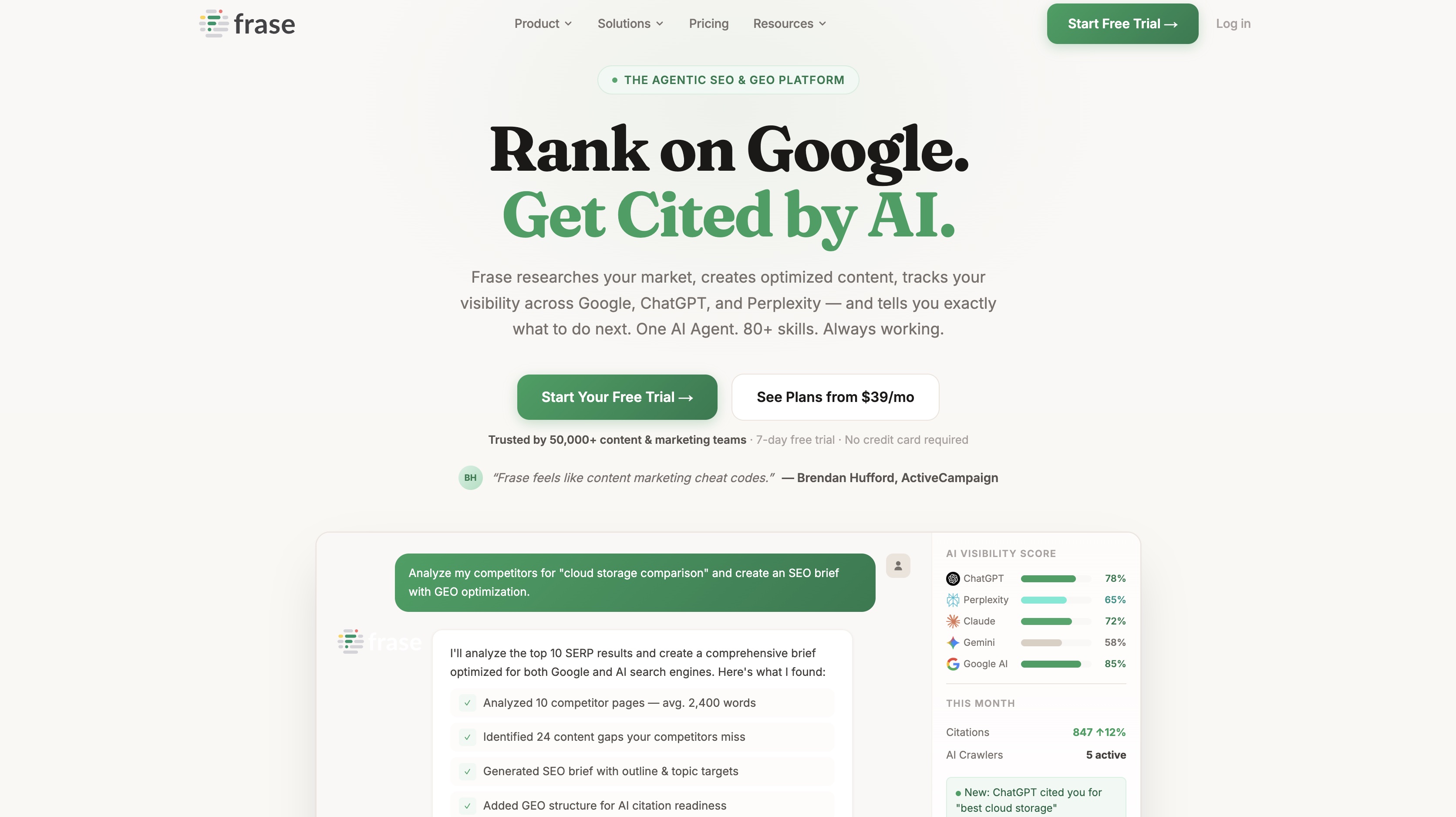
Frase is a well-established name in the AI content field with a good reputation, making it a safe alternative to Writesonic.
It’s a neat and tidy tool with excellent organizational features during the planning and research stages of creating content.
It also offers strong analytical tools built with AI, allowing visibility across all major AI platforms.
Additionally, the real-time editing feature can really help to fine-tune content pieces if you want to squeeze every last bit of SEO performance out of each one.
It’s also starting to make inroads into the GEO landscape, with content optimized for all major AI search engines.
A major drawback to Frase is its lack of free plan, so you need to be sure it’s the right one before making a full commitment.
It does offer some of its tools for free to have a look at, though this isn’t a comprehensive way of fully getting to know the platform.
Pros
- High reputation
- Strong SEO content performance
- Community templates for versatility
Cons
- No free plan
- Some untidy functionality during content creation
Jasper
Jasper is another name you’ll often find as an alternative to Writesonic, with a broad set of AI writing tools capable of delivering a versatile range of content.
Its Jasper Grid and Jasper Studio tools offer automation to deliver high-volume content in a short space of time, making it a great option for full-scale marketing agencies who have a lot of clients on their books.
For a detailed comparison of how Jasper AI stacks up against other tools, see our Machined.ai vs Jasper AI comparison.
Its agentic systems also allow for a smooth workflow from start to finish, from idea generation all the way to publication.
And with an LLM-agnostic architecture in place, it can work seamlessly with all of the leading AI search engines.
Jasper does have a number of paid add-ons which are useful, but they would perhaps be expected to be a standard feature in a paid plan (such as a plagiarism checker).
It also only offers one paid plan (other than a customized Enterprise plan) which makes it a less flexible option than others.
Pros
- Great for high-volume, quality content
- Versatile range of content creation
- Excellent templates
Cons
- Only one paid plan
- Drafting based on consensus information
Copy.ai
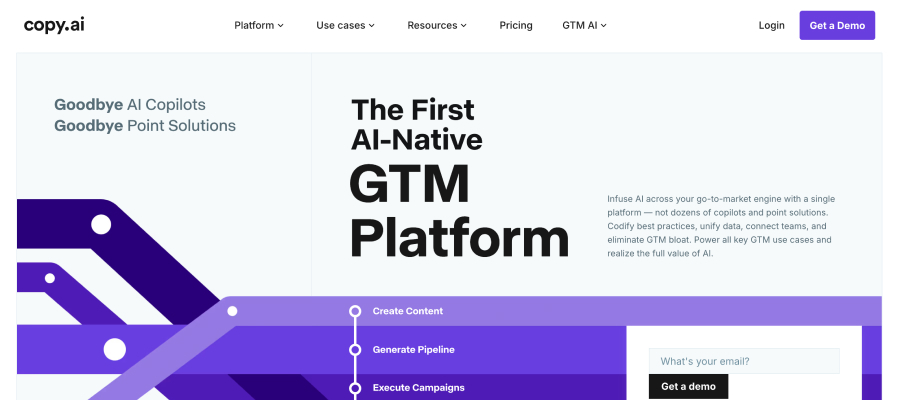
Copy.ai is recognized as a go-to-market (GTM) tool, so it’s a little more wide-ranging than a standard AI writing tool.
As a result, some of the features specific to AI content creation can feel a little more diluted than for other names on this list.
That being said, the workflow automations are very solid. It has several functions that you won’t find throughout the rest of the list, including the ability to create an entire email campaign from start to finish.
This is a very much a tool for marketers, with features for sales and analytics teams as well as content creation.
Its starting price of $29/mo is quite generous, but this does scale enormously up to $249/mo if you wish to upgrade.
Content results can also be quite vague unless it receives very specific prompts or briefs.
Pros
- Great as an all-round marketing tool, including content creation
- Strong automated workflows
- Beginner-friendly
Cons
- Content results are less in-depth
- Limited features on the free plan
Rytr
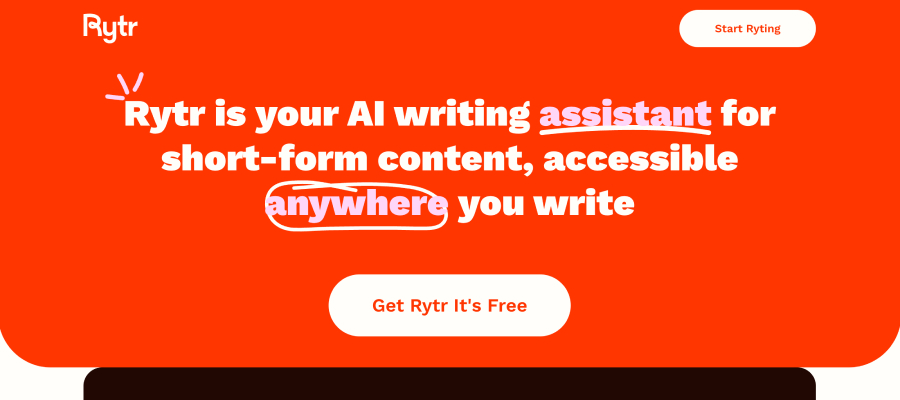
Rytr specializes in short-form content (though it can manage long-form as well) making it a good option if you’re looking for a tool to help with CTAs and product descriptions.
It can also seamlessly integrate with Google Chrome, which is excellent if your business uses the Google product range.
To see how Rytr compares to other popular tools, check out our Jasper AI vs Rytr, Copy.ai vs Rytr, and Copy.ai vs Jasper comparisons.
For something that’s on the relatively cheap end, it’s surprisingly intuitive.
It integrates aspects such as tone and voice smoothly into the final content results, which will help to maintain consistency across your messaging.
And while it doesn’t perhaps have the breadth of features or AI capability as some of the others on this list, it’s a good option for beginners and small businesses.
Plans currently start at just $7.50/mo, with a free plan available.
Pros
- Budget-friendly
- Strong for tonal consistency
- A well-established, trusted brand
Cons
- Slightly limited overall features
- No real SEO prioritization
Anyword
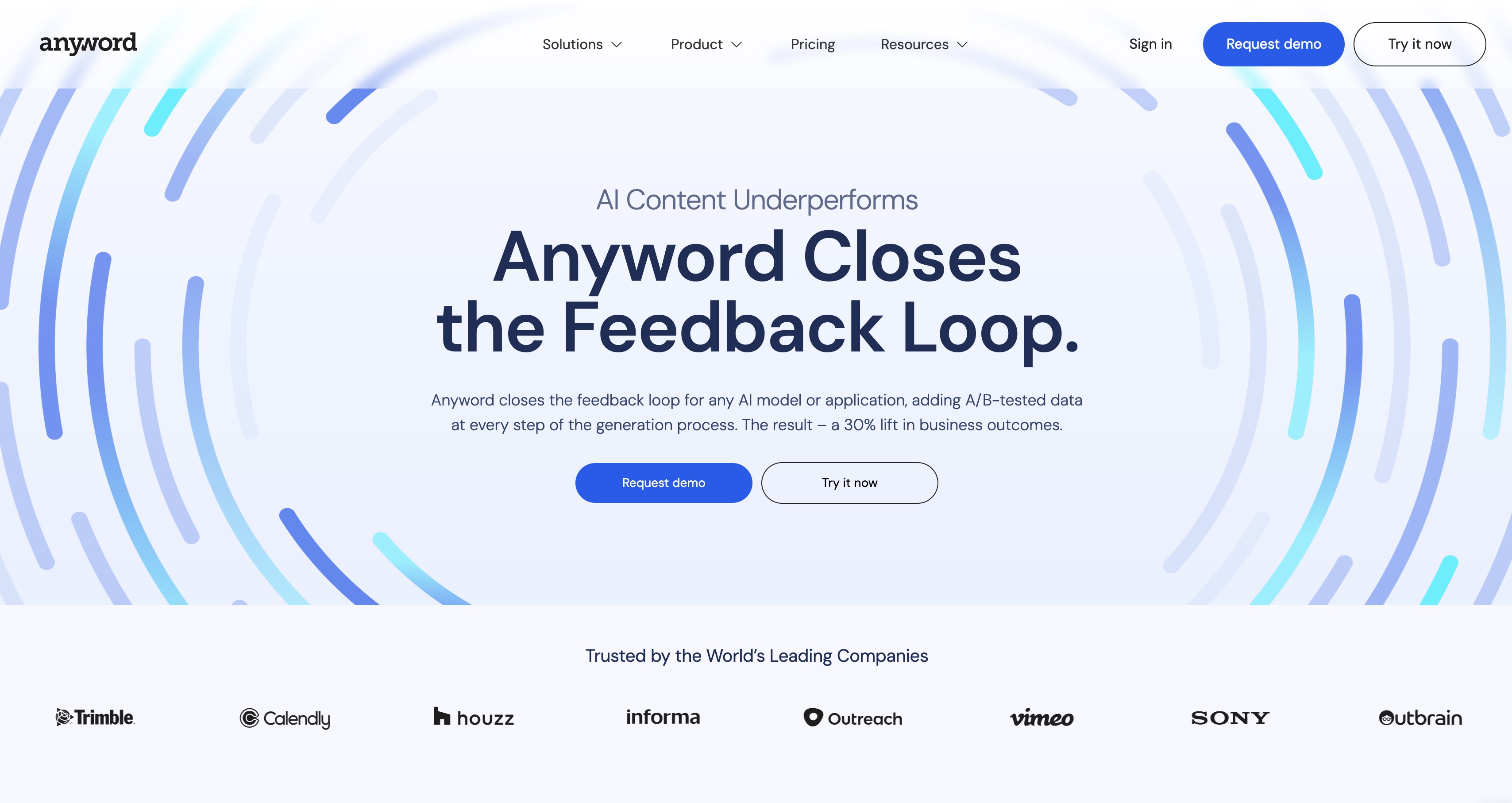
Anyword is a versatile AI writing tool that can produce several types of high-quality content, ranging from social media posts to blog articles, all informed by strong SEO performance.
Where it seems to really excel is what goes on in the background, with performance predictions a stand-out feature. It’s also the only name on this list that explicitly prioritizes A/B testing to achieve the best results.
Users are able to train Anyword to generate optimized content based on high-performing posts. It integrates well with external applications including ChatGPT and Grammarly, with real-time feedback for ongoing drafts.
This is a well-rounded tool for marketers who place a lot of emphasis on testing and data. Its starter plan is a little steep ($49/mo). And it has been noted for its lack of originality on occasion.
Pros
- Intelligent testing and performance predictions
- Strong external integration
- Personalized messaging
Cons
- Content can lack originality
- Requires more human input than other tools
Simplified
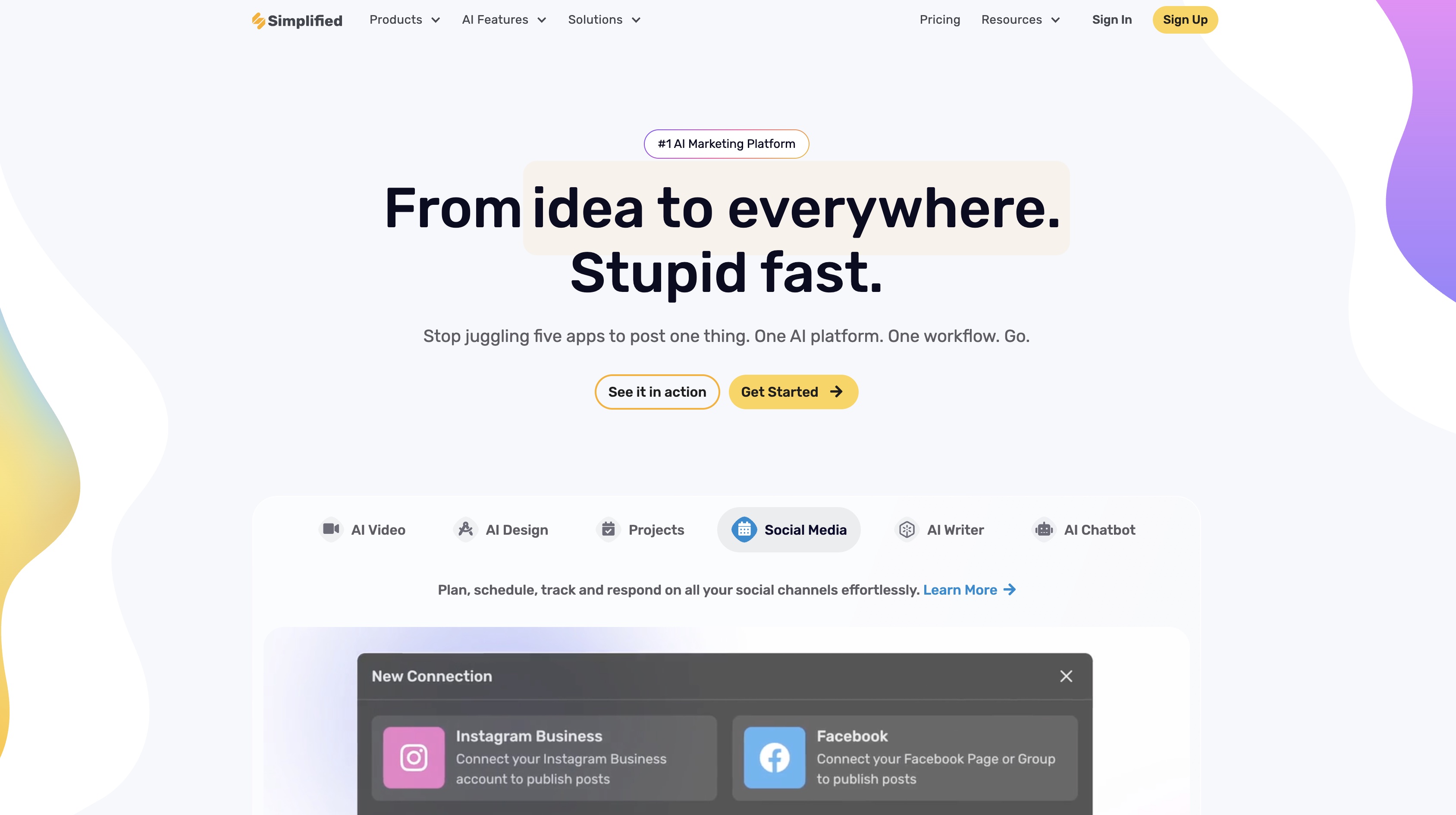
Simplified is another name that offers more of an all-round solution to content creation.
While it does offer some excellent versatility in terms of written content, with over eighty templates to help you out, it also provides video and design tools as part of each plan.
This all-in-one approach might appeal to marketers with an omnichannel approach to their strategy.
On the writing side of things, it has the capability of delivering both short- and long-form content, with an AI Rewriter tool available to help improve quality and readability.
It offers idea generation to get you started with your long-term content calendar, and can help with brand tone customization for consistency.
It’s also very well-priced, with a generous free plan available and paid plans starting at just $12/mo.
As it doesn’t account for writing specifically, it might not cover all of these bases in such depth as other names. But it’s certainly a good all-round option.
Pros
- Wide-ranging content types
- Additional multimedia features
- Generous pricing
Cons
- Not as in-depth on the writing side
- Potentially steep learning curve
WordHero
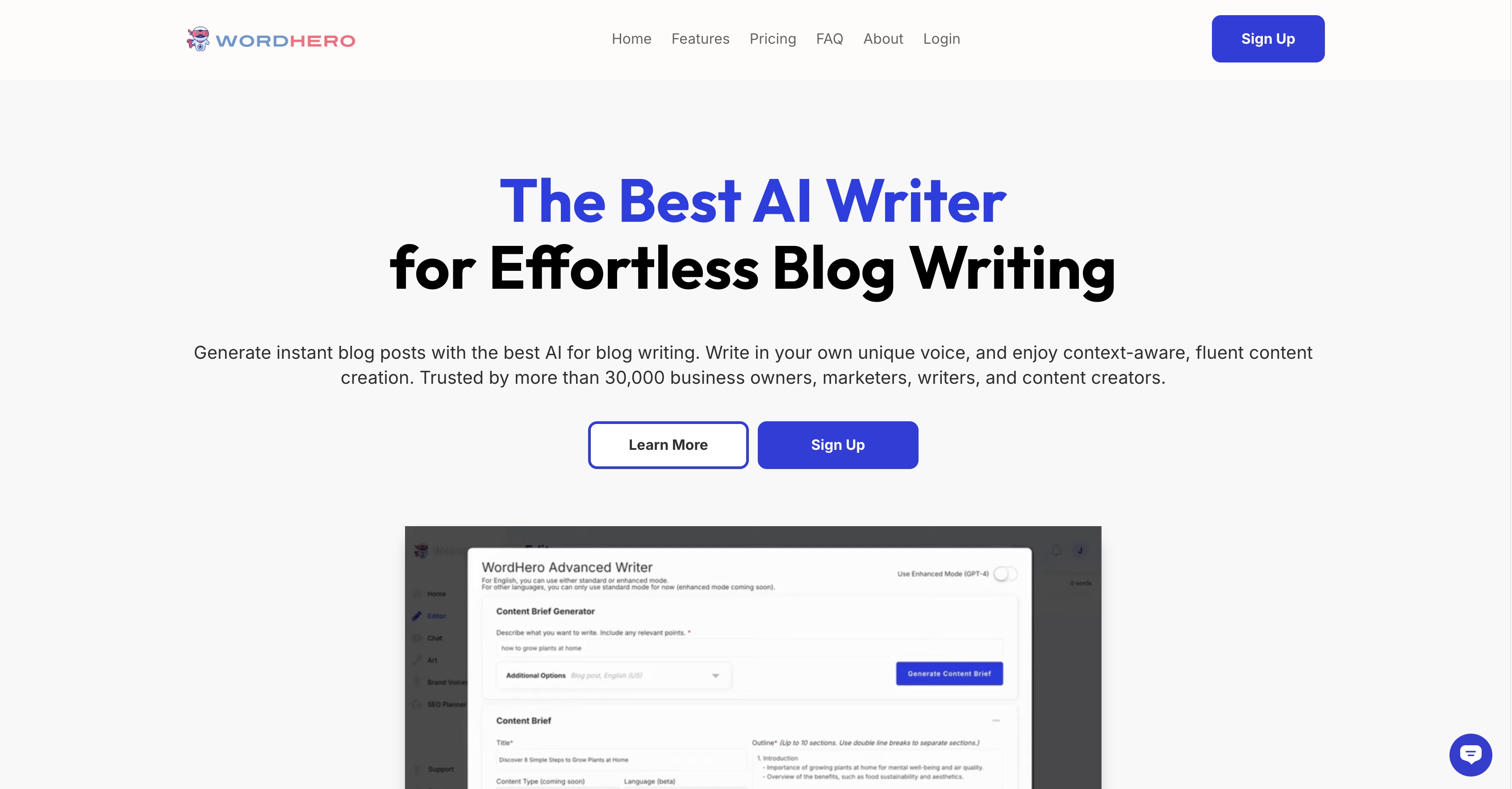
WordHero is built for speed, with the ability to turn blog ideas into full-length posts quickly and effortlessly.
It comes with a number of built-in SEO tools for decent ranking performance as well as an unlimited word count, making long-form content an option as well.
However, it won’t produce this all at once; instead, it’ll deliver content as and when the user adds headings, rather than generating these by itself.
It also has its WordHero Art feature, giving the option to compliment blogs and articles with striking or nuanced images.
And it has the unusual perk of an entire user manual, which you get for free when signing up.
It’s well-priced for what you get; however, it does work on a token-based system (on top of the monthly subscription) which can quickly add up if you need a lot of content in a given month.
For more options, see our WordHero alternatives guide.
Pros
- High-volume, quality content
- High multilingual capabilities
- Additional image creation included
Cons
- Slightly stilted workflow
- No in-depth emphasis on SEO
BrandWell
BrandWell, formally known as Content at Scale, our final name on this list is a little more niche than the others.
It’s very much designed for enterprise businesses working in technical fields.
So while you won’t find much help for snappy, short-form content, you’ll have an excellent resource to support you with creating research-backed, long-form technical articles across a variety of industries.
It’s also stacked with high-end analytics, with optimization auditing and reporting available at the click of a button.
It prides itself on its level of humanization, with its content designed to replicate human output very closely.
With what’s on offer here, it might not surprise you to learn that BrandWell doesn’t come cheap.
You’ll need $249/mo just for the Essentials package, while the Agency plan will set you back $499/mo.
Pros
- Outstanding for long-form content
- High levels of domain authority
- Advanced analytics
Cons
- Very high price
- Not suitable for beginners
Where Machined.ai Stands Out as a Writesonic Alternative
Hopefully you can now see that there is more to content creation than just Writesonic.
Our list covers all the bases, from in-depth technical long-form content all the way through to short-form, high-volume writing.
At Machined.ai, we’re attempting to offer something a little different. We don’t just want to churn out content and follow a scattergun approach to generating web traffic.
Our goal is to provide:
- Optimal, cluster content designed to increase domain authority and crawlability with seamless navigation.
- A tool for businesses who care more about SEO and GEO than quick copy.
- Automation and control across things such as CMS, webhooks, and API keys
- Credible, well-maintained content that will increase reader trust and loyalty.
If this aligns with your content strategy, explore Machined.ai’s pricing options and start with our 7-day free trial: full access to the Launch plan to test our cluster-based approach to SEO content, no credit card required.