
Content Clusters: The Complete Guide to Building Topical Authority
Genuine topical authority, the kind that gets your site to the top of Google, no longer comes from keywords alone. Google now evaluates your entire site's expertise on a topic before deciding whether to show your content to searchers.
One standalone article about marathon training might struggle to rank. But a cluster covering training plans, nutrition, injury prevention, and race day strategy?
That tells Google you're a genuine authority, and it rewards you accordingly.
What is a Content Cluster
A content cluster (or topic cluster) is a group of interlinked pages on your website, all focused on a single topic.
At the centre sits a pillar page, a comprehensive overview of the main subject, surrounded by cluster pages that dive deeper into specific subtopics.
Internal links tie everything together, signalling to both readers and search engines that your site thoroughly covers the topic.
The results speak for themselves.
One SEO practitioner split a single long-form article into a proper topic cluster and saw traffic increase by 100x.
Minuttia built a single cluster around "product launch" for SaaS company Viral Loops and ranked for over 1,100 keywords from near-zero visibility. There are countless other cases just like these two.
This guide will walk you through exactly how to plan, build, and maintain content clusters that establish your site as the go-to resource in your space.
Content clusters aren’t about publishing more content. They’re about organising what you publish so Google clearly sees you as the authority on a topic.
Why Content Clusters Work
For years, SEO was a keyword game. Find a keyword, write a page, build some links, rank. Google changed the rules.
Starting with the Hummingbird update in 2013, Google shifted from matching keywords to understanding topics. Its algorithms began interpreting search queries in context, linking them to broader subjects.
Then came the Helpful Content Updates (2023-24), which took things further, penalising low-quality content and promoting the most valuable, comprehensive results for a user's query.
This is how we ended up with Google's current E-E-A-T framework:
- Experience: how much first-hand experience the content creator has with the topic.
- Expertise: how reliably the creator can comment on the topic at hand.
- Authoritativeness: how well-recognised the website is as a source in the field.
- Trustworthiness: how accurate and transparent the content is for users.
A strong content cluster strategy works across all four pillars, but it's particularly powerful for demonstrating Authoritativeness.
Google has even formalised this with what it calls "Topic Authority," a system that determines which sources are truly expert on a subject.
While Google initially described this in the context of news sites, the principle applies everywhere: sites that demonstrate deep, comprehensive knowledge of a topic earn preferential treatment in search results.
The logic is straightforward. If someone searches for "how to train for a marathon," Google wants to send them to a site that can answer not just that question, but all the follow-up questions too.
What should I eat? How do I avoid injury? What pace should I target?
If your site has thorough answers to all of these, you become the obvious choice.
One article can rank for one thing. A content cluster can dominate an entire topic.
Anatomy of a Content Cluster
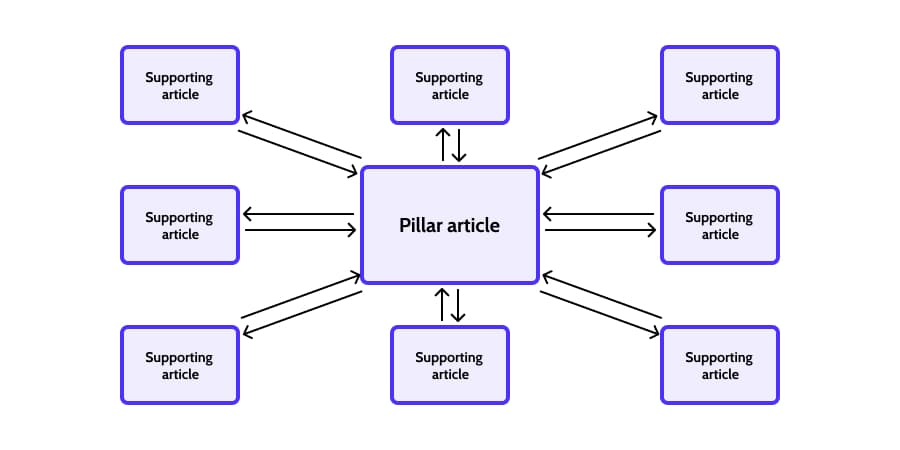
Every content cluster has three components: a pillar page, cluster pages, and the internal links connecting them.
The Pillar Page
Your pillar page is the hub. It's a comprehensive resource that covers your main topic broadly, touching on every major aspect without going too deep into any single one.
Think of it as the table of contents for everything your site has to say about a subject.
For a fitness blog building a cluster around marathon training, the pillar page might be titled "The Complete Guide to Marathon Training."
It would cover the fundamentals: how to structure a training plan, the importance of nutrition, common mistakes beginners make, what to expect on race day, and so on.
Each section provides enough information to be useful on its own, but also links out to dedicated cluster pages that go deeper.
Pillar pages tend to be longer than typical blog posts, often 2,000 to 4,000 words, because they need to establish the scope of the entire topic. But length isn't the goal. Comprehensiveness is.
Cluster Pages
Cluster pages are the supporting cast. Each one takes a specific subtopic from your pillar page and explores it in detail.
Continuing the marathon example, your cluster pages might include:
- A 16-week marathon training schedule for beginners
- What to eat before, during, and after long runs
- How to prevent common running injuries
- Choosing the right running shoes for marathon training
- Mental strategies for pushing through the wall
- How to taper before race day
Each cluster page should be able to stand on its own. Someone landing directly on "What to eat before a marathon" should get a complete, satisfying answer. But it also exists within a larger ecosystem, linking back to the pillar and to related cluster pages.
Internal Links
Internal links are what transform a collection of related articles into an actual cluster. Without them, you just have blog posts that happen to be about similar things.
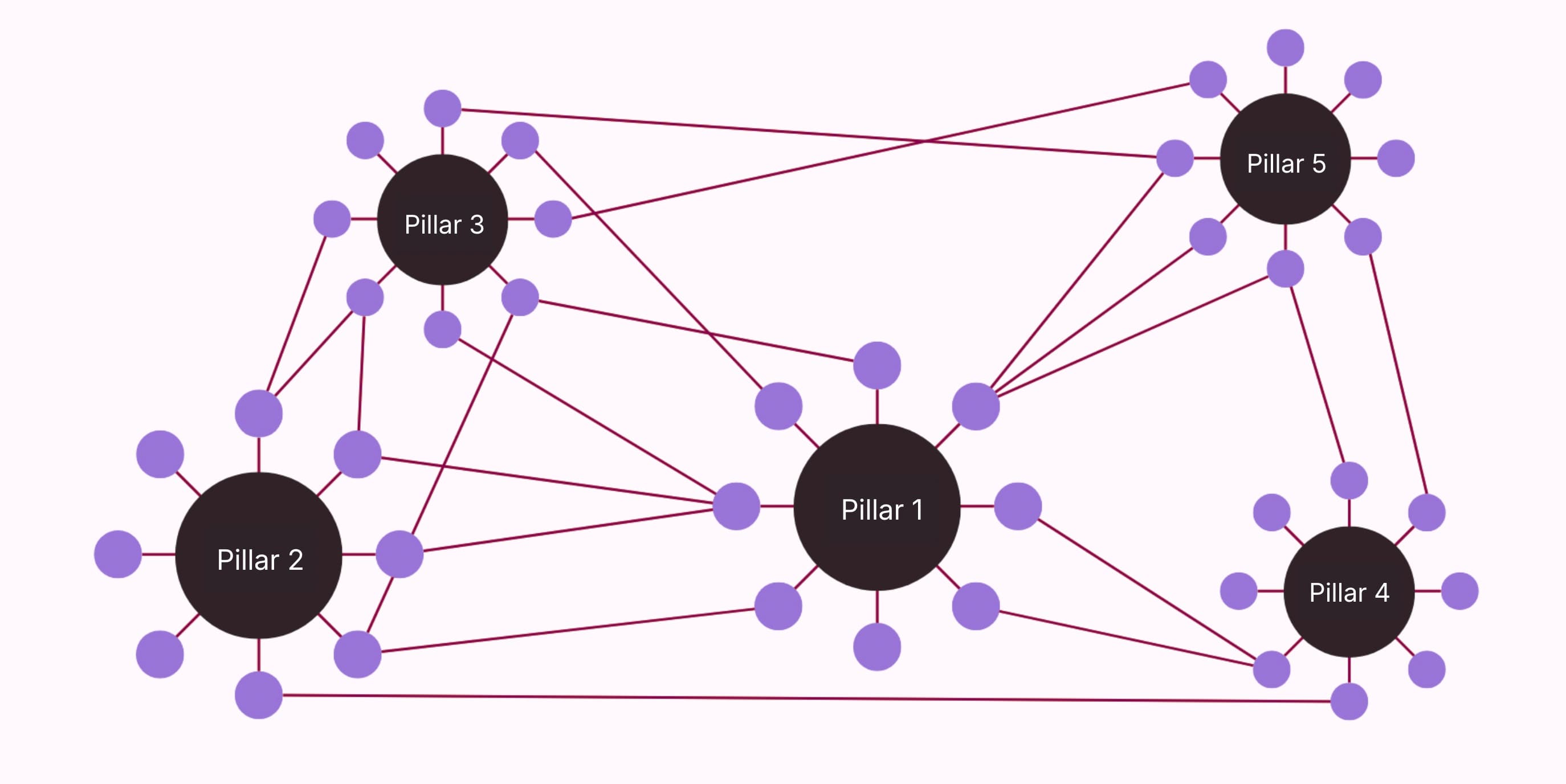
The linking structure follows a hub-and-spoke pattern. Your pillar page links out to every cluster page. Each cluster page links back to the pillar. And where it makes sense, cluster pages link to each other. Your article on nutrition might naturally reference the article on long runs, for instance.
These links serve two purposes. For readers, they create natural pathways through your content, helping them find answers to questions they didn't know they had. For search engines, they make the relationship between your pages explicit, reinforcing that your site covers this topic comprehensively.
How to Choose Your Topic Clusters
The first and sometimes the hardest part of building a content cluster strategy is identifying the right topics.
Knowing the difference between a pillar page topic and a cluster page topic is one thing ("Marathon Training Guide" vs. "Nutrition Tips for Marathon Training," for example), but finding the best possible topics is another.
1. Start with Business Alignment
Before touching any keyword tool, ask yourself: what do we want to be the authority on?
If you're not sure, think about:
- Products or services you offer
- Common customer questions
- Industry pain points
- Competitor content categories
- Topics you could talk about endlessly
Then group related ideas into broad themes.
This step matters because your cluster topic should connect to what you sell, what you offer, or what you want people to associate with your brand. Building a cluster on a topic that has nothing to do with your business might drive traffic, but it won't drive results.
2. Validate Search Demand
Choosing topics is one thing, but you need to make sure people are actually searching for them before you invest time and money into building a cluster.
Use keyword research tools like Google Keyword Planner, Ahrefs, SEMrush, or Ubersuggest to check:
- Monthly search volume
- Related keyword ideas
- Question-based searches
- Long-tail variations
You're looking for two things specifically: a main topic with meaningful search volume (this becomes your pillar), and a constellation of related subtopics that people also search for (these become your cluster pages).
For "marathon training," you'd find substantial search volume for the main term, plus thousands of related queries: marathon training plan, marathon nutrition, marathon for beginners, how long to train for a marathon, and so on.
That's a cluster waiting to happen.
3. Use the Goldilocks Principle
Your topic needs to be broad enough to sustain multiple articles but narrow enough to stay focused. As a rule of thumb, you'll want 10 to 20 articles per cluster.
Here's a simple example:
- Too broad: "Fitness" could mean anything. You'd never finish building that cluster, and your content would lack cohesion.
- Too narrow: "Best yoga mat for tall beginners" doesn't warrant a cluster. It's one article, maybe two.
- Just right: "Marathon training" is specific enough to have a clear focus but broad enough to support 15 to 20 articles covering different aspects.
4. Use a Litmus Test
As a final quality check, ask yourself one question:
Can we eventually answer every major question someone might have about this topic?
This is what true authority is all about. If the answer is yes, and that would require at least 10 to 15 distinct articles, you've found your cluster topic. If big questions fall outside your scope, the topic may be too narrow or poorly defined.
How to Research and Plan Your Cluster
With your topics chosen, it's time to map out the cluster. This is where you identify your pillar keyword, find all the subtopics worth covering, and organise them into a logical structure.
1. Find Your Pillar Keyword
Your pillar keyword is the main search term you want your pillar page to rank for. It's typically broader and more competitive than the keywords your cluster pages will target.
Using a tool like Ahrefs or SEMrush, search for your topic and look at the results.
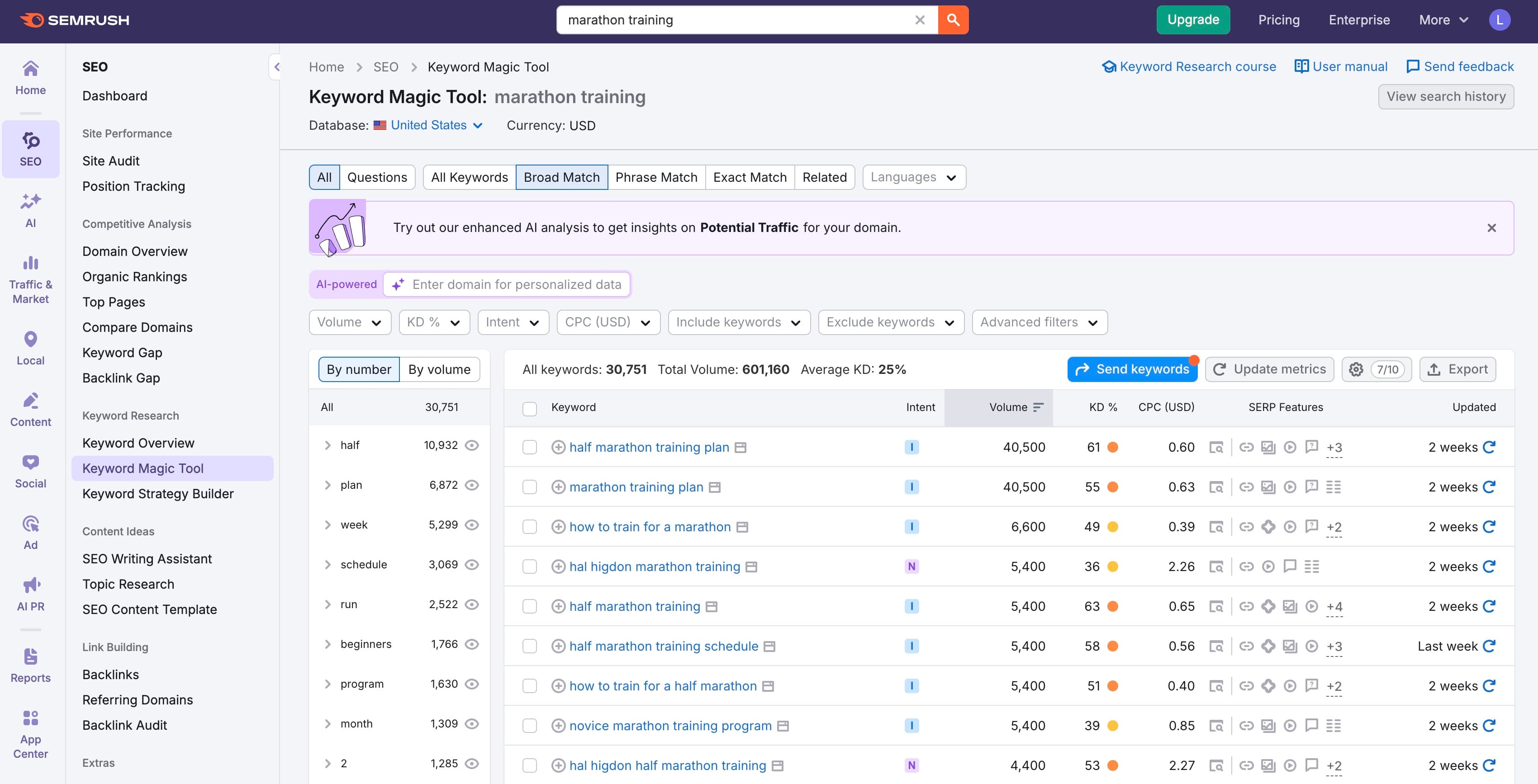
For marathon training, you might see:
- "marathon training" with high volume and high competition
- "marathon training plan" with high volume and high competition
- "how to train for a marathon" with moderate volume and moderate competition
Any of these could work as your pillar keyword. The choice depends on your site's current authority and what angle you want to take. A newer site might target "how to train for a marathon" since it's slightly less competitive. An established site might go after "marathon training" directly.
2. Find Subtopics
Now comes the expansive part: finding every subtopic worth covering. You'll use a mix of tools and manual research.
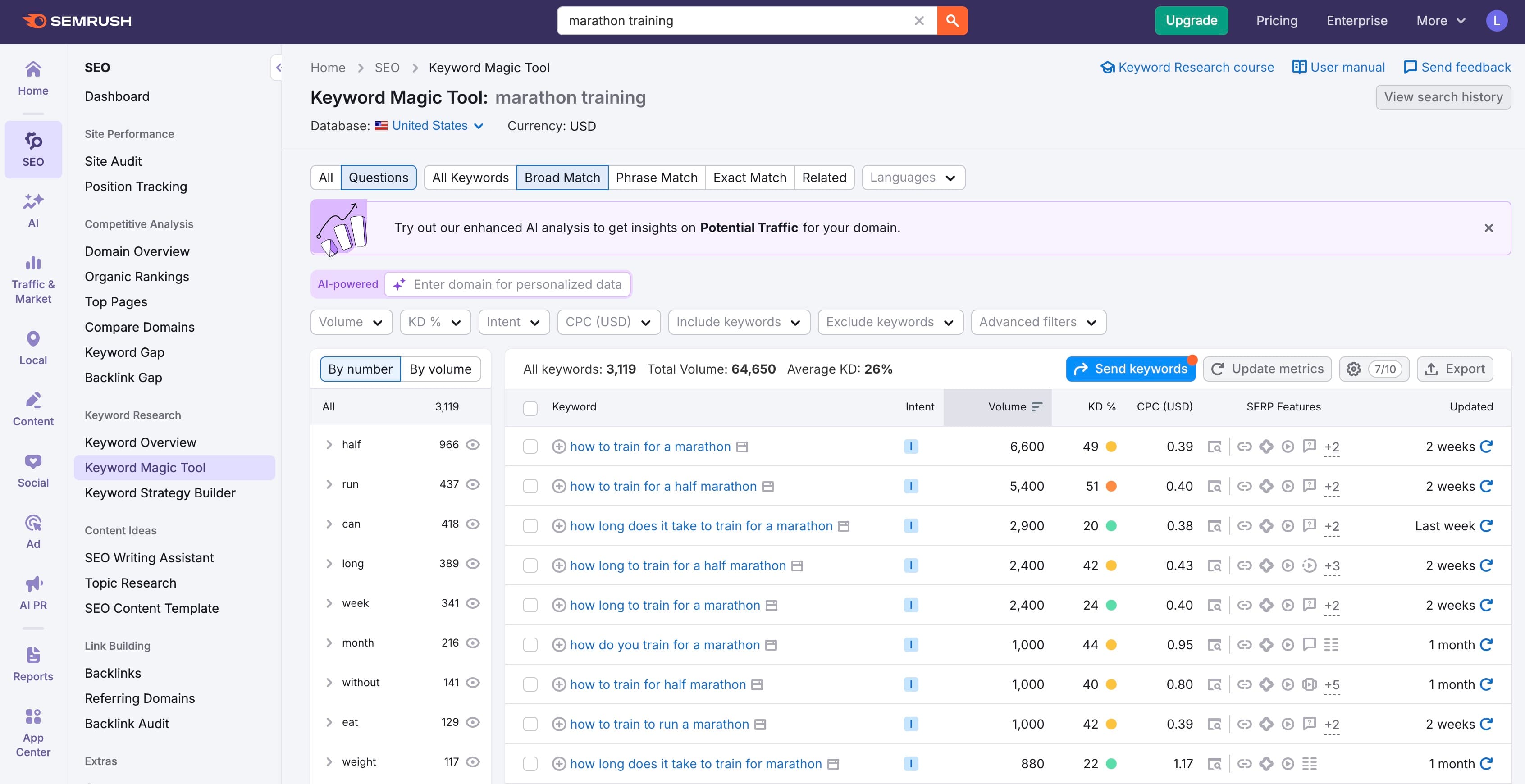
Keyword tools: In Ahrefs or SEMrush, look at the "Questions" or "Related keywords" reports for your pillar keyword. These surface hundreds of queries people actually search for. Filter for informational intent to focus on topics suited for educational content.
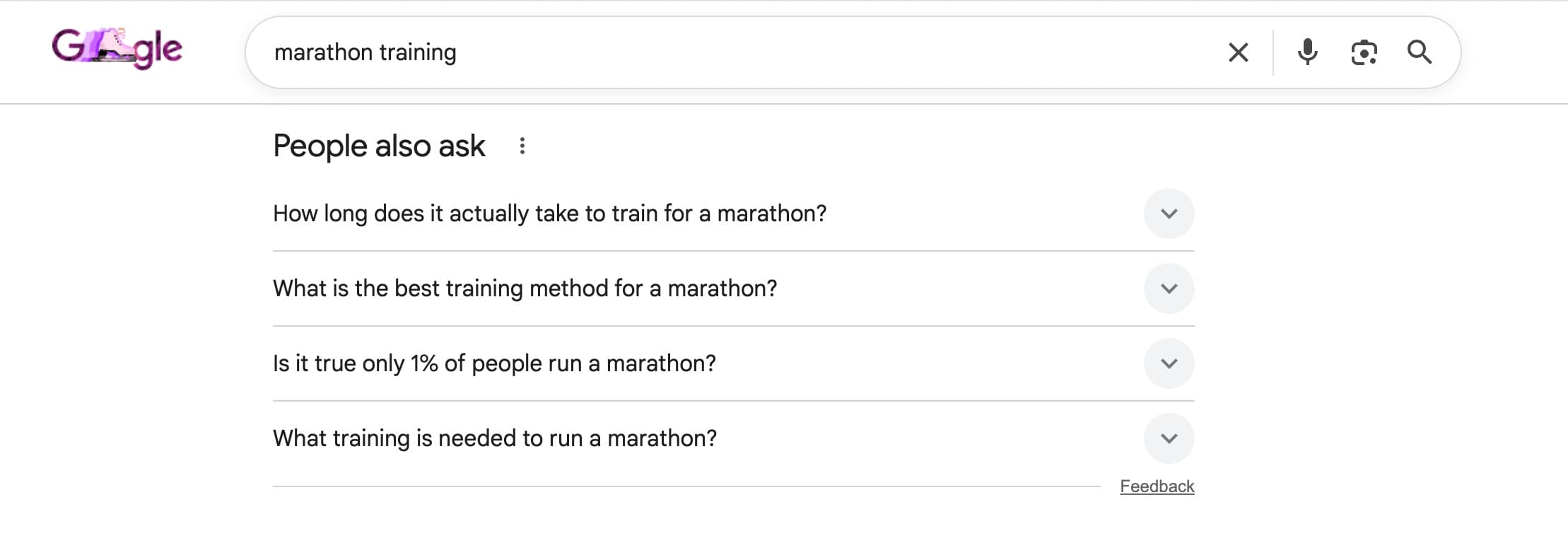
People Also Ask: Search your main topic in Google and expand the "People Also Ask" boxes. Keep clicking. Each expansion reveals more questions. These are gold for cluster page ideas because they're literally what searchers want to know.
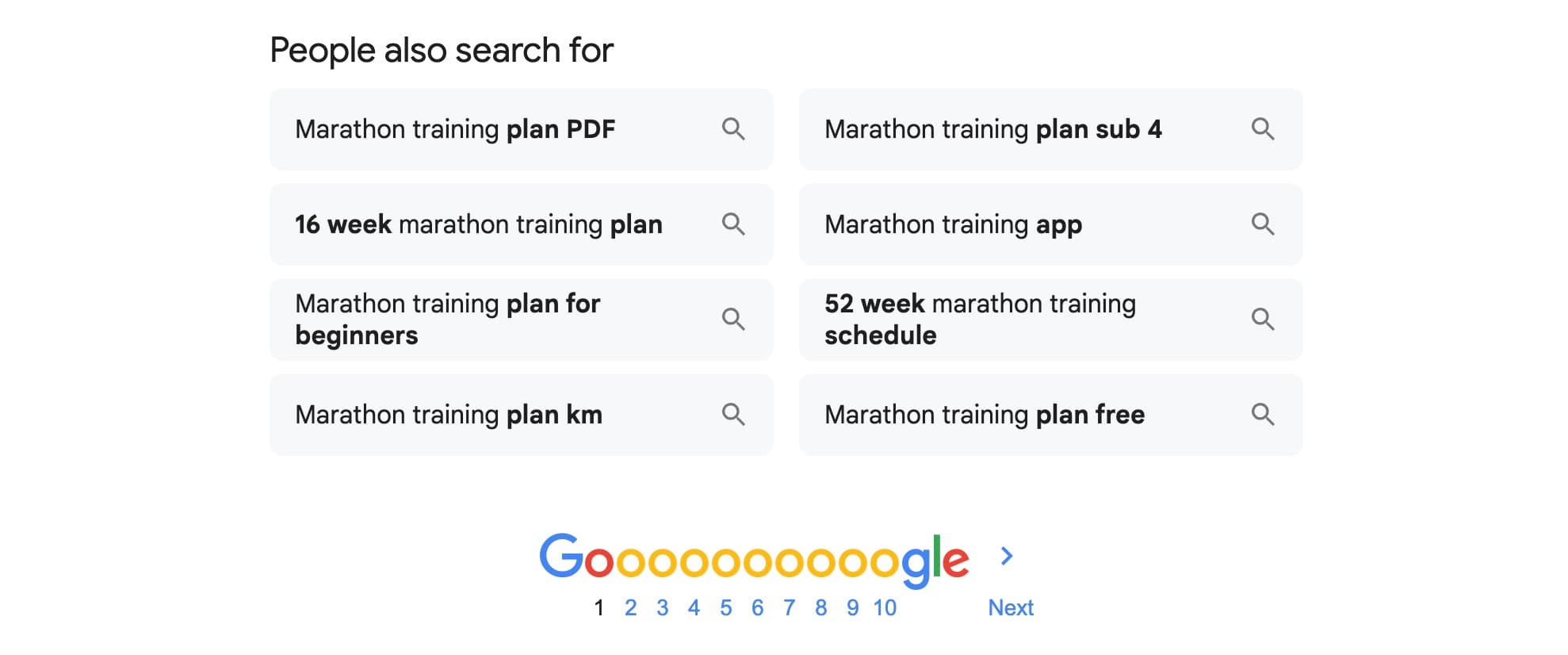
Related searches: Scroll to the bottom of Google's results page for related searches. These often reveal angles you hadn't considered.
Competitor content: Find sites that already rank well for your topic and look at what they've covered. Tools like Ahrefs' Content Gap report can show you topics they rank for that you don't.
For the marathon training cluster, this research might surface subtopics like:
- Training schedules (16-week, 12-week, beginner, advanced)
- Nutrition (before runs, during runs, carb loading, hydration)
- Gear (shoes, clothing, watches, accessories)
- Injury prevention (common injuries, stretching, recovery)
- Mental preparation (motivation, race day nerves, hitting the wall)
- Race logistics (what to expect, pacing strategy, post-race recovery)
3. Map Search Intent
This step is often overlooked but is absolutely essential. You need to analyse why people are searching for your keywords, not just what they're searching.
There are four main types of search intent:
- Informational: users are researching a topic or looking for learning materials (guides, how-tos, explainers).
- Commercial: people are comparing options and thinking about buying something.
- Transactional: the user is ready to buy.
- Navigational: the user is looking for a particular brand or site.
The key thing to remember: content clusters are usually focused on informational and commercial searches. The goal is to use authority to gently guide readers towards your solution, not to sell them something out of the blue.
4. Group Keywords into Logical Pages
One of the biggest mistakes beginners make is assuming "one keyword = one page."
That's the wrong way to think about it. Your ultimate goal is topical authority, not just ranking for a single keyword. It's perfectly fine to group similar keywords with the same intent into one article.
An article that covers a topic thoroughly, not just a single phrase, can rank for multiple related keywords from a single page.
The aim is one comprehensive guide per subtopic.
How to Structure Your Pillar Page
Your pillar page is your core resource, so it needs to be well-structured and easy to navigate. It's often the first page in your topic cluster a reader comes across, so it has to signal professionalism and comprehensiveness from the start.
Cover the Topic Broadly
The pillar page isn't where you go deep. That's what cluster pages are for. Instead, you're providing a thorough overview that touches on every major aspect of the topic.
For the marathon training pillar, you might have sections covering:
- What marathon training involves and who it's for
- How to create a training schedule
- The role of nutrition in marathon preparation
- Essential gear for training
- Preventing and managing injuries
- Mental preparation and race day strategy
- Recovery after the marathon
Each section provides enough information to be useful on its own. Someone should come away understanding the basics even if they read nothing else.
But you're also teeing up your cluster pages, giving readers a reason to click through for more detail.
Make It Scannable
Most users don't read pillar pages in full. They scan to find the section or cluster page they're looking for. Don't get in their way.
Use:
- Clear headings that describe each section
- A table of contents with jump links at the top
- Short, easily scannable paragraphs
A table of contents is particularly effective for pillar pages. It signals comprehensiveness immediately and lets readers navigate directly to what interests them.
Integrate Links Naturally
Every section of your pillar page should link to the relevant cluster page. But these links should feel natural, not forced.
Instead of: "Click here to read our article on marathon nutrition."
Try: "Nutrition plays a crucial role in marathon training.
What you eat in the months leading up to race day can make or break your performance." The phrase "what you eat" or "nutrition" links to your cluster page.
The goal is to create links that readers actually want to click because they're genuinely curious, not because you've told them to.
Two great examples of pillar pages in practice are Zapier's "ultimate guide to remote work" and HubSpot's "what is inbound marketing?"
Both demonstrate clear structure, scannable formatting, and natural internal linking throughout.
How to Write Effective Cluster Pages
Cluster pages are where the real depth happens. While your pillar provides breadth, cluster pages go deep on specific subtopics. They have to be in great shape because this is where you deliver the most value to your readers.
Avoid Overlap
Every individual cluster page should focus on a single, clearly defined subtopic.
If you find yourself covering multiple distinct subtopics, you probably need multiple pages.
This matters because when multiple pages on your site target the same keyword, they compete against each other in search results. This is called keyword cannibalisation.
Google gets confused about which page to show, and often neither ranks as well as a single, focused page would.
Before writing a new page, check whether you already have content covering that subtopic. If you do, update the existing page rather than creating a competing one.
One subtopic, one page.
Match Depth to Search Intent
Not every cluster page needs to be 3,000 words. Match your content depth to what the searcher actually needs.
Someone searching "what to eat the night before a marathon" wants a clear, practical answer. A focused 800-word article that directly answers the question outperforms a meandering 2,500-word piece that buries the answer.
Conversely, "16-week marathon training plan" probably warrants significant depth, with week-by-week breakdowns, explanations of different workout types, and modifications for different fitness levels.
Let the topic and the searcher's intent guide your length, not arbitrary word count targets.
Link to Pillar and Sibling Pages
Every cluster page should link back to the pillar page at least once, typically early in the content. This reinforces the relationship between the pages.
But also look for opportunities to link between cluster pages where it makes sense. Your nutrition article might naturally reference your article on long runs. Your injury prevention piece might link to your article on proper running form.
These cross-links strengthen the entire cluster.
The reader doesn't want to go back to the pillar page every time. Make it easy for them to move between related cluster pages directly.
Keep Readers Moving
Think about where someone might want to go after reading your cluster page. What's the natural next question?
Someone who just read about marathon nutrition might be interested in hydration strategies during the race. Someone who read about injury prevention might want to learn about recovery techniques.
Throughout each cluster page, and especially at the end, guide the reader to the next logical step. Including relevant internal links keeps readers engaged with your site rather than bouncing back to Google.
Internal Linking Best Practices
Internal linking is fundamental to content clustering. Without it, the cluster isn't so much a cluster as a group of strangers. Algorithms and readers need to see how everything connects.
You can master internal linking in your content cluster strategy by following four important principles (automated internal linking services can even handle this automatically):
Two-Way Linking
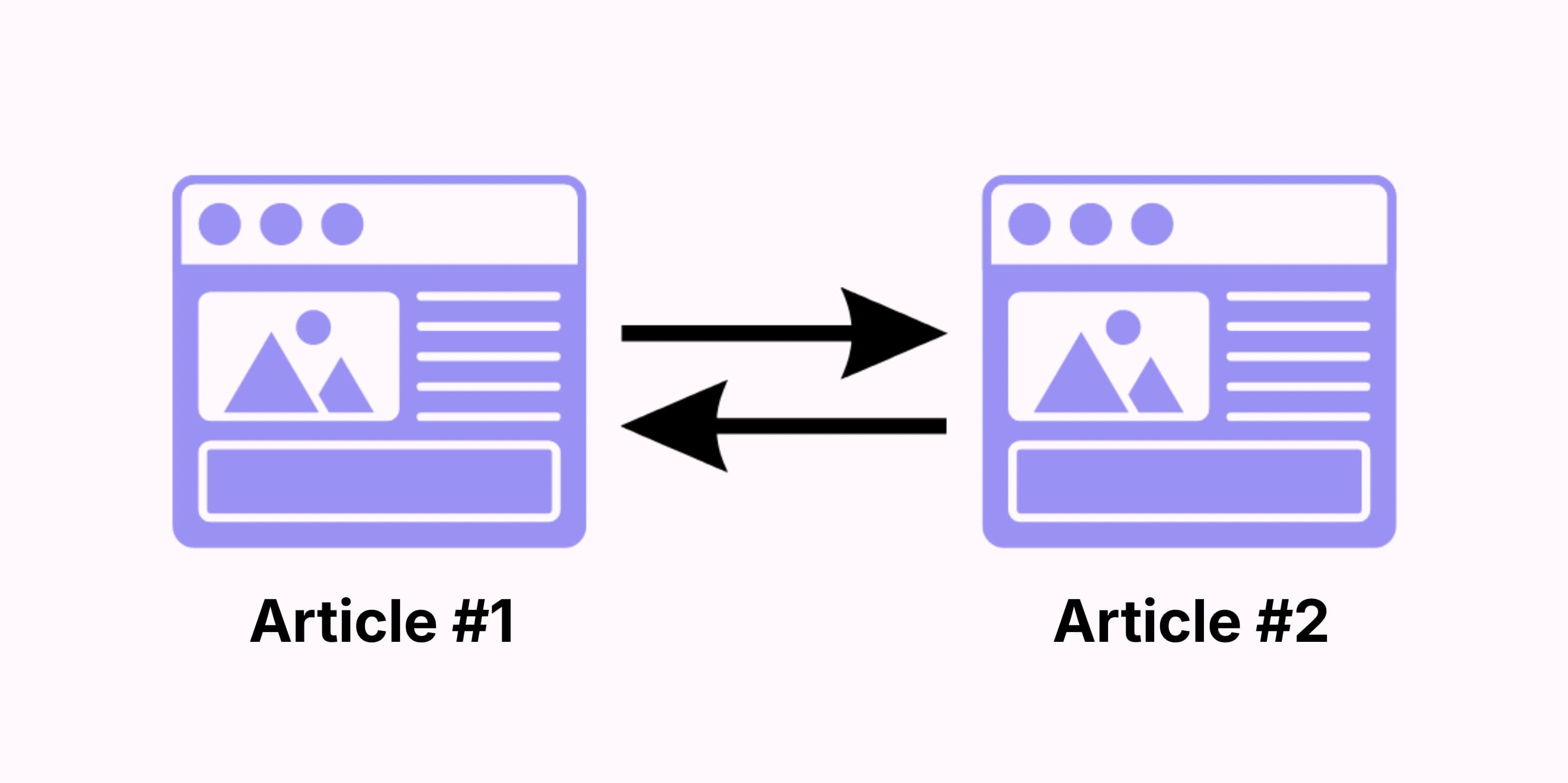
At minimum, every cluster page should link to the pillar page, and the pillar page should link to every cluster page. This two-way linking is non-negotiable.
But many sites stop there, missing the opportunity to link between cluster pages.
If your article on tapering naturally mentions nutrition, link to your nutrition article. If your race day strategy piece references mental preparation, link to that cluster page.
The goal is a web of interconnected content, not a simple hub-and-spoke where the pillar is the only connection point.
Cross-Link Cluster Pages
Cluster pages should link to the pillar page, but they should also link to other related cluster pages. The key word there is "related." Make sure every cross-link connects to a relevant page someone reading the article might find useful.
Use Descriptive Anchor Text
The clickable text of your links tells both readers and search engines what the linked page is about. Make it descriptive and natural.
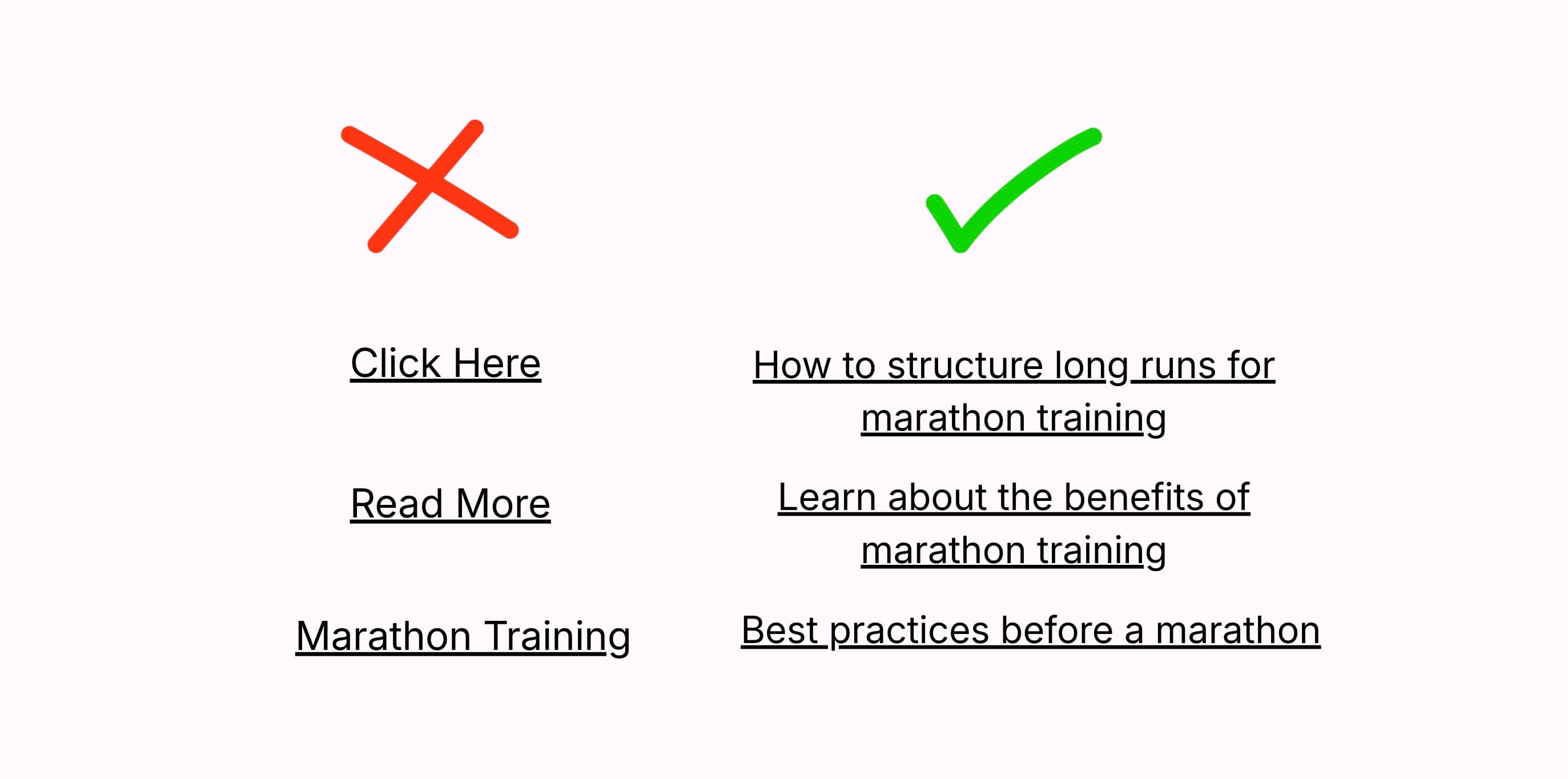
Weak: "Click here to learn more."
Better: "A proper marathon taper typically begins two to three weeks before race day."
The second version tells Google that the linked page is about marathon tapering. It also tells readers exactly what they'll find if they click.
Avoid over-optimising by using the exact same anchor text repeatedly. Vary your language naturally while keeping it descriptive.
Place Links Within Body Content
Links placed within the body of your content, surrounded by relevant text, carry more weight than links in sidebars or footers. Take the time to add links within paragraphs where they're more likely to be noticed and supported by context.
Common Mistakes to Avoid
Content clustering requires time and careful attention to detail. It's natural for first-timers to make mistakes. Hopefully this list will help you avoid the most common pitfalls.
Going Too Broad
The temptation to cover everything under one cluster leads to unfocused content that never quite establishes authority. "Fitness" is too broad. "Running" is probably too broad. "Marathon training" is focused enough to build a genuine cluster around.
If your cluster could reasonably contain 50 or more articles, it's too broad. Narrow down until you have something you could realistically dominate.
Keyword Cannibalisation
When multiple pages on your site target the same keyword, they compete against each other in search results. Google gets confused about which page to show, and often neither ranks as well as a single, focused page would.
Avoid this by giving each cluster page a distinct focus. Before writing a new page, check whether you already have content covering that subtopic. If you do, update the existing page rather than creating a competing one. Focus keywords by subtopic and stick to it.
Orphan Pages
An orphan page has no internal links pointing to it. It exists on your site but isn't connected to anything else. Search engines may struggle to find it, and it contributes nothing to your cluster's topical authority.
Every cluster page needs at least one link from another page on your site, ideally several. Audit your content periodically to catch orphans and link them properly. Don't rely on organic SERP traffic alone.
Set-and-Forget Mentality
Content clusters aren't finished when they're published. Topics evolve. Information becomes outdated. New questions emerge that your cluster doesn't yet answer.
Build maintenance into your content calendar. Review your clusters quarterly to identify pages that need updates, subtopics you should add, and outdated information that needs refreshing. Every time new content is uploaded, review your links to make sure you're maximising cross-link opportunities. The sites that dominate topics are the ones that keep their clusters current.
Measuring Content Cluster Strategy Success
Content clustering is a proven method for increasing organic traffic significantly. However, you might not see results immediately. One of the toughest parts of any content cluster strategy is figuring out if it's actually working.
Measure the performance of content clusters as a group, not just page by page. Clusters win when multiple pages grow together.
Follow these principles to measure your success:
Track Clusters Holistically
Don't evaluate pages individually. Instead, measure the performance of the whole cluster by analysing:
- Total organic traffic across all pages in the cluster
- Total ranking keywords for the topic
- Search impressions growth (this often increases before clicks do, so it's an important early signal)
- Overall visibility increase
A cluster is working when traffic grows across multiple pages, not just one.
Look for Topical Authority Growth
It takes time to become the go-to authority in your niche. Look out for these specific signals as your cluster matures:
- Faster indexing: new pages in your cluster get indexed more quickly than unrelated content.
- Ranking for untargeted keywords: you start appearing for related terms you didn't explicitly optimise for.
- Featured snippets: Google pulls your content for featured snippets, People Also Ask boxes, or other enhanced results.
- Stable rankings: your positions hold steady or improve even as competitors publish new content.
Expand or Consolidate
If your cluster is performing well, expand it.
Add new subtopics, go deeper on existing ones, and keep strengthening your authority.
If new questions or trends appear, or new keyword research uncovers subtopics you haven't addressed, build them out.
If pages are underperforming, look at consolidation.
Sometimes two thin articles perform better as one comprehensive piece. If multiple pages are competing for the same keywords or some pages are stuck with little to no traffic, think about merging and improving existing content.
Let the data guide your decisions, but give clusters time to mature before making major changes. Six to twelve months is a reasonable timeline to evaluate performance.
Conclusion
If there's one thing to take away from this guide, it's that content clustering is about building topical authority, not content volume. The goal isn't to increase the amount of content on your site but to organise that content to make it more valuable for both users and search engines. The approach works because it aligns with how Google now evaluates content, not page by page, but topic by topic.
Sites that demonstrate deep knowledge through interconnected, well-maintained clusters earn the rankings and traffic that come with topical authority.
Getting started doesn't require complex tools or technical expertise. Choose a topic your business should own. Research what your audience wants to know. Build out your pillar and cluster pages. Link them thoughtfully. Keep them updated. The compound effect takes time, but it's worth the investment.
That said, building content clusters manually can be time-consuming, especially the research, keyword clustering, and internal linking. Machined automates these steps, helping you build topical authority faster without getting lost in spreadsheets.
About the Authors

Machined Content Team
AuthorOur content team combines detailed research and industry knowledge to create comprehensive, unbiased, and useful articles for anyone ranging from small business and startup owners to SEO agencies and content marketers.
Nick Wallace
ReviewerLong time SEO professional with experience across content writing, in-house SEO, consulting, technical SEO, and affiliate content since 2016. Nick reviews all content to ensure accuracy and practical value.