
Americans Say AI Makes Them More Confident and Capable - But It's Complicated
The public conversation around AI often frames it as a shortcut that weakens critical thinking and discourages effort. The concern is understandable: if AI can write our emails, explain complex topics, and solve problems for us, what happens to our ability to do those things ourselves?
To get a better understanding of how Americans actually perceive AI's effect on their abilities, Machined.ai surveyed 2,000 US adults on the topics of confidence, motivation, and learning, as they relate to AI. The results paint a more nuanced picture than either the hype or the hand-wringing might suggest. A majority report positive effects, but another cohort acknowledges growing dependency, and nearly everyone has concerns about what comes next.
- 62% report feeling smarter or more knowledgeable in a conversation because of AI
- Two-thirds agree that AI helps them take action on things they used to procrastinate
- However, 34% say AI has made them both more confident and more dependent
- Only 8% of Americans say they have no concerns about AI usage in learning and education
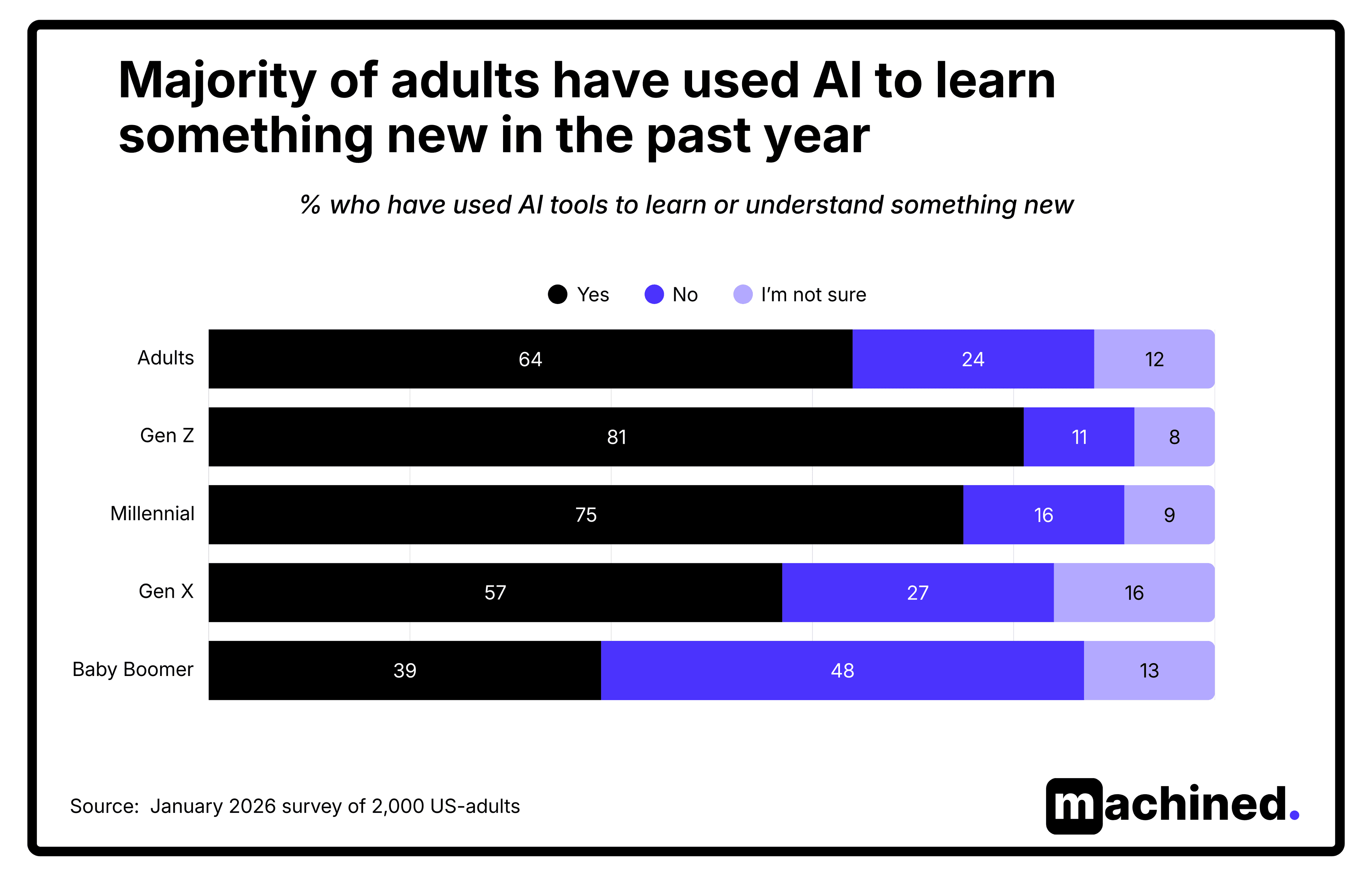
- 64% of adults, including 81% of Gen Zers, have used AI to learn something new in the past year
Perceived Gains in Confidence
When asked whether AI has ever helped them feel smarter or more knowledgeable in a conversation, 62% say yes. Thirty-four percent report this has happened multiple times, and another 28% say it has happened at least once or twice. Among Gen Zers, 73% have experienced this. Whether this reflects genuine knowledge gain or a confidence boost from having quick access to information is an open question.
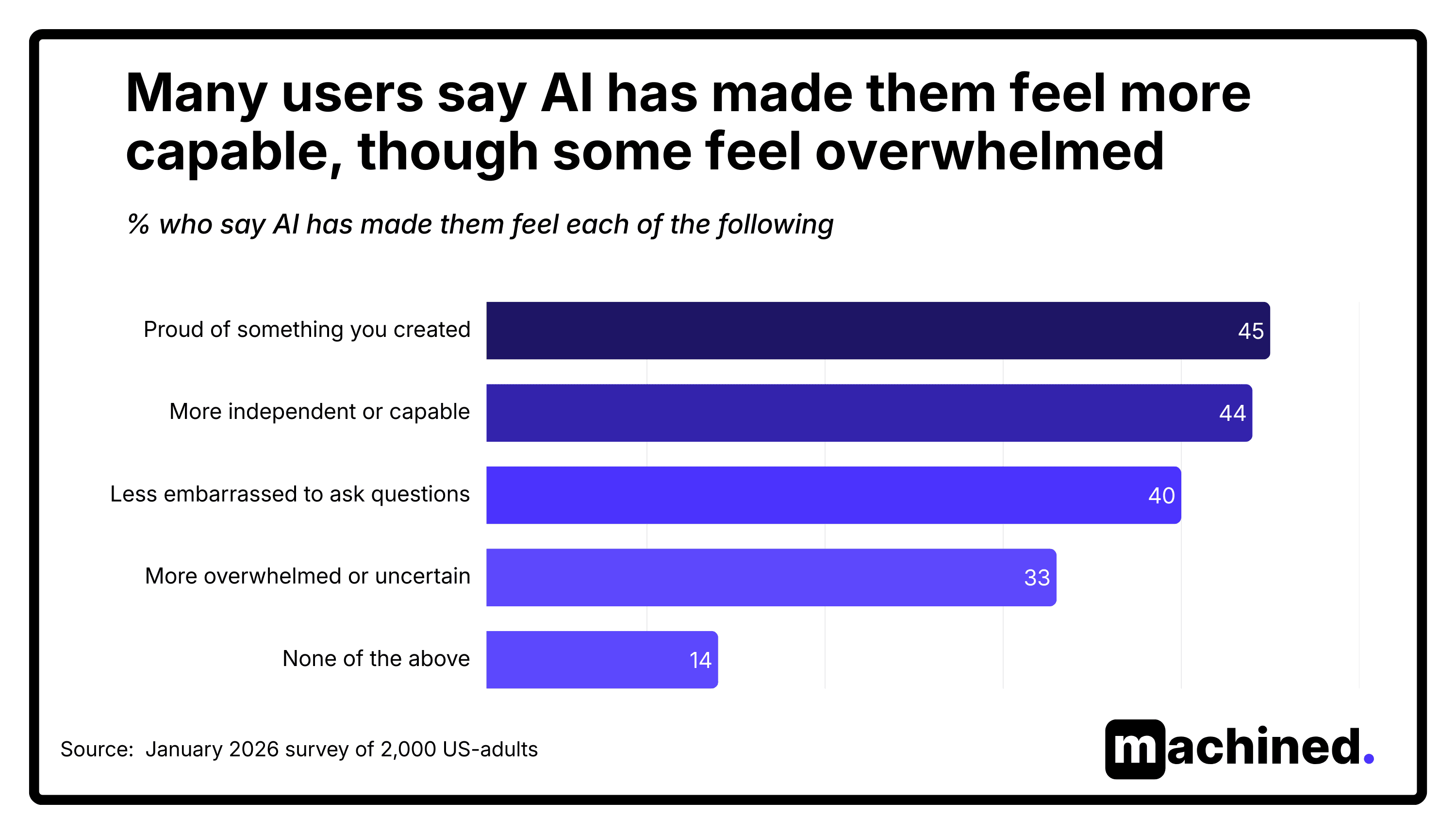
Forty percent of respondents say AI makes them feel less embarrassed to ask questions when learning something new. By lowering the barrier to gathering baseline knowledge, AI may give users the confidence to engage with topics and people they might have previously avoided, though critics might argue this sidesteps the valuable friction of working through confusion independently.
A further 45% of respondents say AI has made them feel proud of something they created, while 44% claim it has made them feel more independent or capable.
More than half of respondents (53%) say they have surprised themselves with what they can accomplish using AI. This self-reported effect is strongest among younger users: 70% of Gen Zers report this experience, compared to 63% of millennials, 50% of Gen Xers, and 31% of baby boomers.
From Procrastination to Action
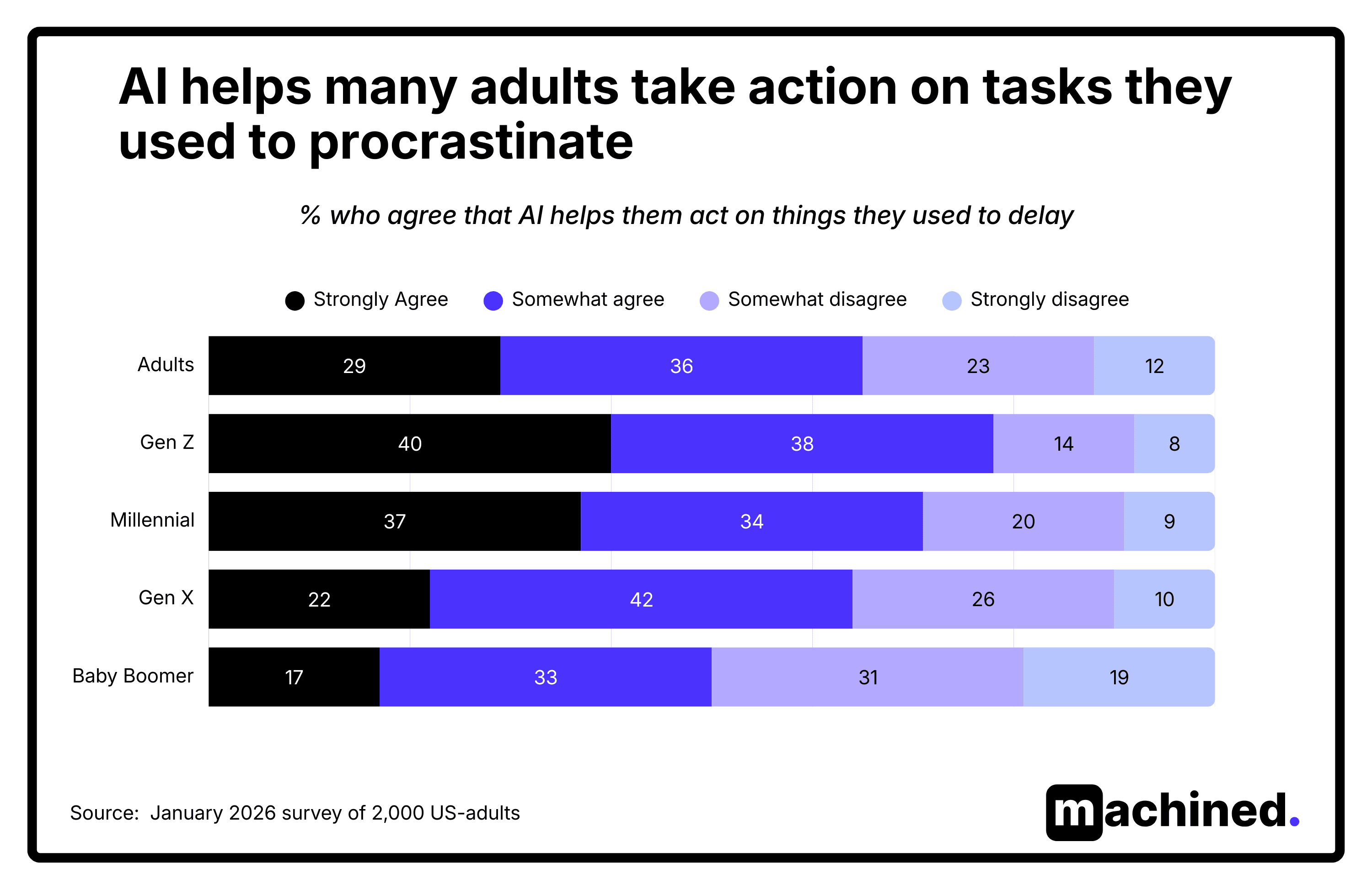
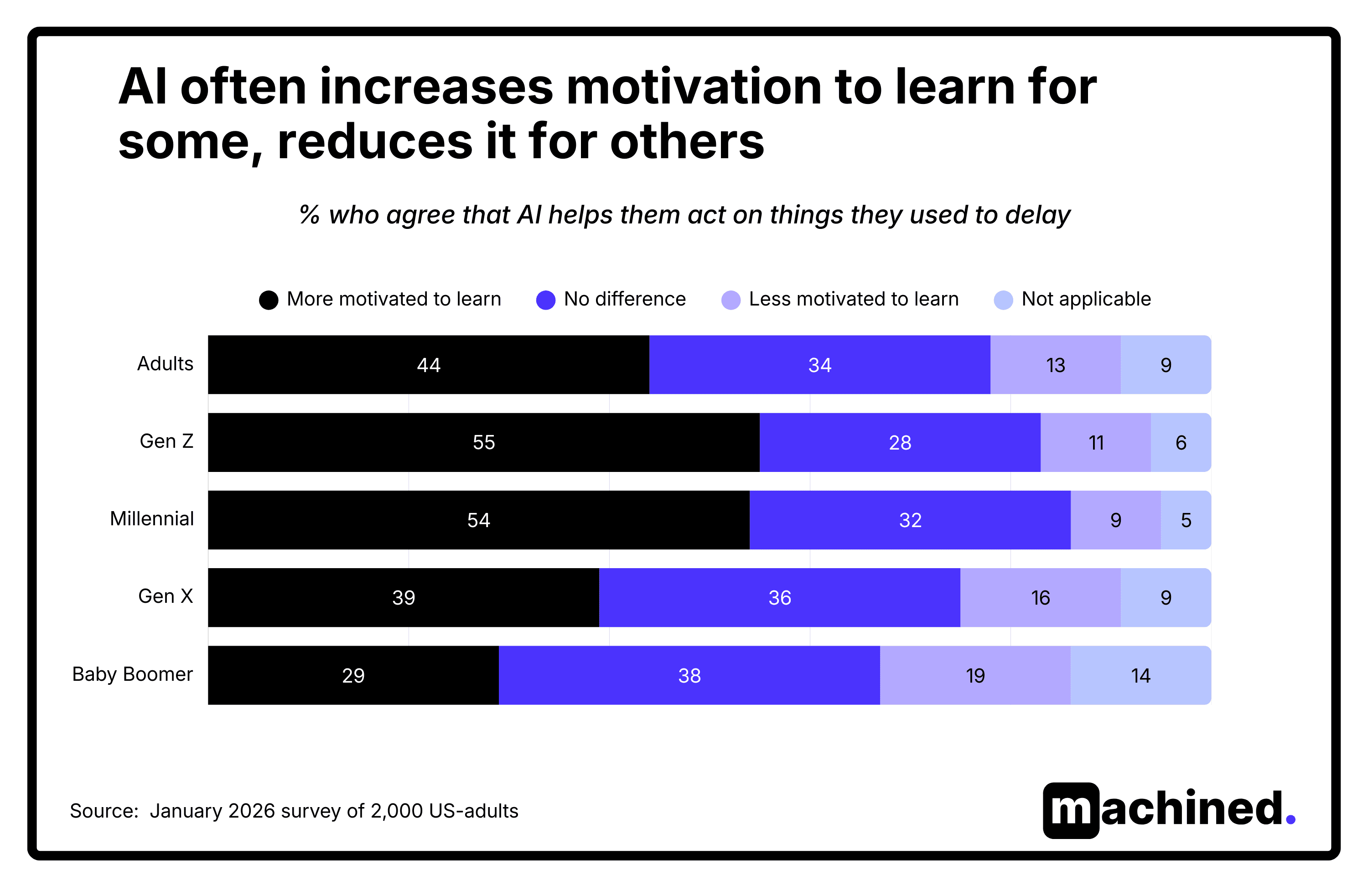
Two-thirds of respondents agree that AI helps them take action on things they used to procrastinate, with 29% strongly agreeing and 37% somewhat agreeing. This effect is most pronounced among younger generations: 40% of Gen Zers and 37% of millennials strongly agree that AI has helped them overcome procrastination, compared to 22% of Gen Xers and 17% of baby boomers.
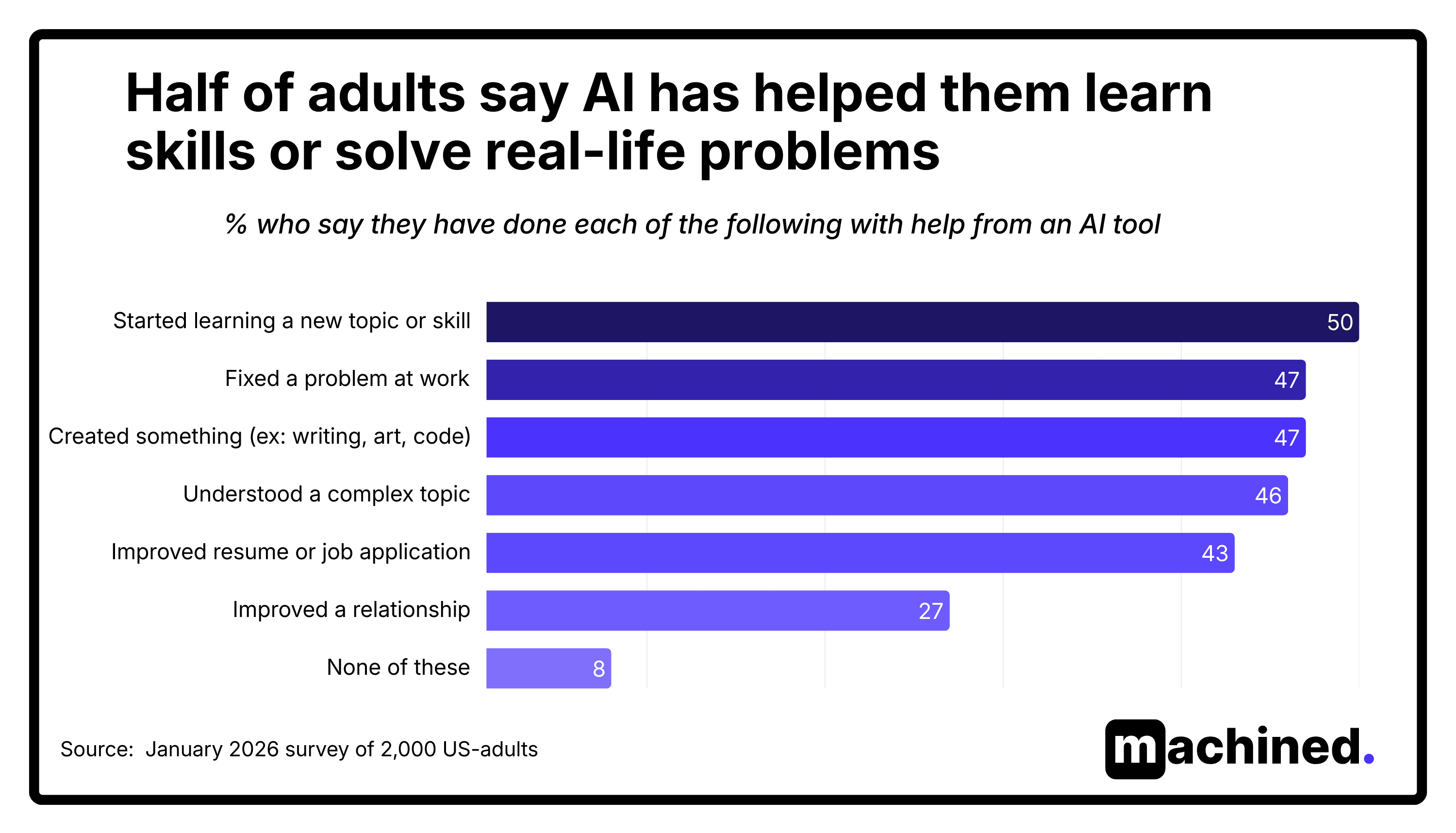
When asked what specific actions AI has enabled, respondents point to a range of outcomes. Half (50%) say AI has helped them start learning a new skill or topic. Nearly as many (47%) say it has helped them fix a problem at work, and the same percentage say it has helped them create something, whether writing, art, or code. Forty-six percent say AI has helped them understand a complex topic, while 43% credit it with improving a resume, email, or job application. More than one in four (27%) say AI has helped them improve a personal relationship or communication with someone.
Making Intimidating Tasks Feel More Approachable
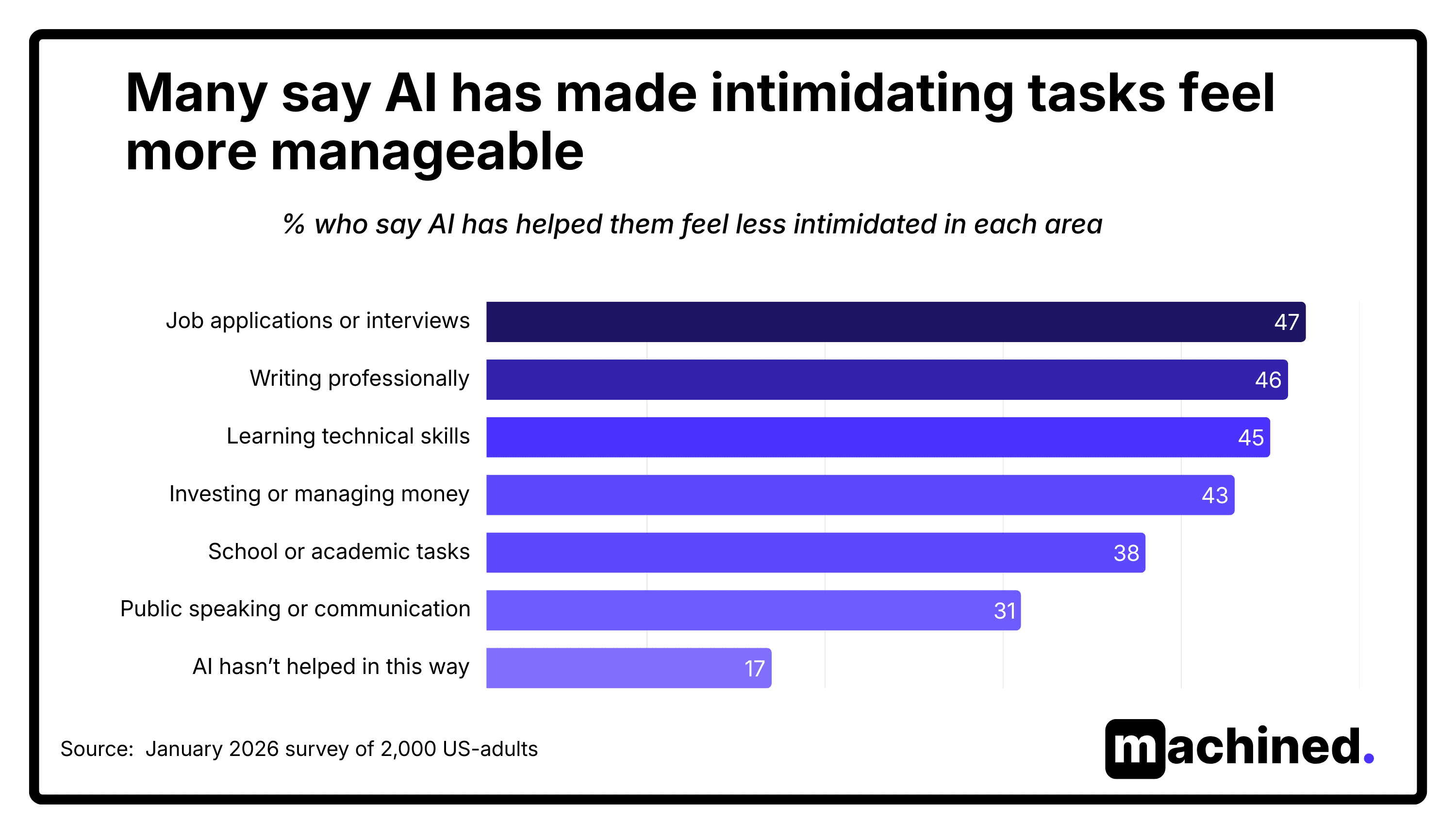
AI also appears to be changing how people approach tasks they previously found intimidating. Nearly half of respondents (47%) say AI has made them feel less intimidated by job applications and interviews, a figure that rises to 55% among Gen Zers and 59% among millennials.
Forty-six percent say writing professionally now feels less intimidating, and 45% report the same for learning technical skills. Managing money and investing, often perceived as requiring specialized knowledge, feels more approachable for 43% of respondents. Even public speaking and communication, consistently ranked among Americans' top fears, feels less daunting for 31%.
For students and lifelong learners, 38% say AI has made school and academic tasks less intimidating. The generational pattern is consistent: 52% of Gen Zers and 45% of millennials report this benefit, compared to 32% of Gen Xers and 21% of baby boomers.
Where Americans Report Confidence Gains
Respondents claim that AI has helped build their confidence across multiple life domains. Learning new skills tops the list, with 54% saying AI has made them more confident in this area. Careers follow closely at 53%, and clear communication at 48%.
Creative pursuits also show reported gains: 44% say AI has boosted their confidence in creative hobbies like art, music, and writing. Forty-five percent feel more confident managing money or investing, and 43% say AI has improved their understanding of news, politics, or science. Even parenting and home life show reported benefits, with 31% indicating increased confidence in this area.
Personal Uses Beyond Work
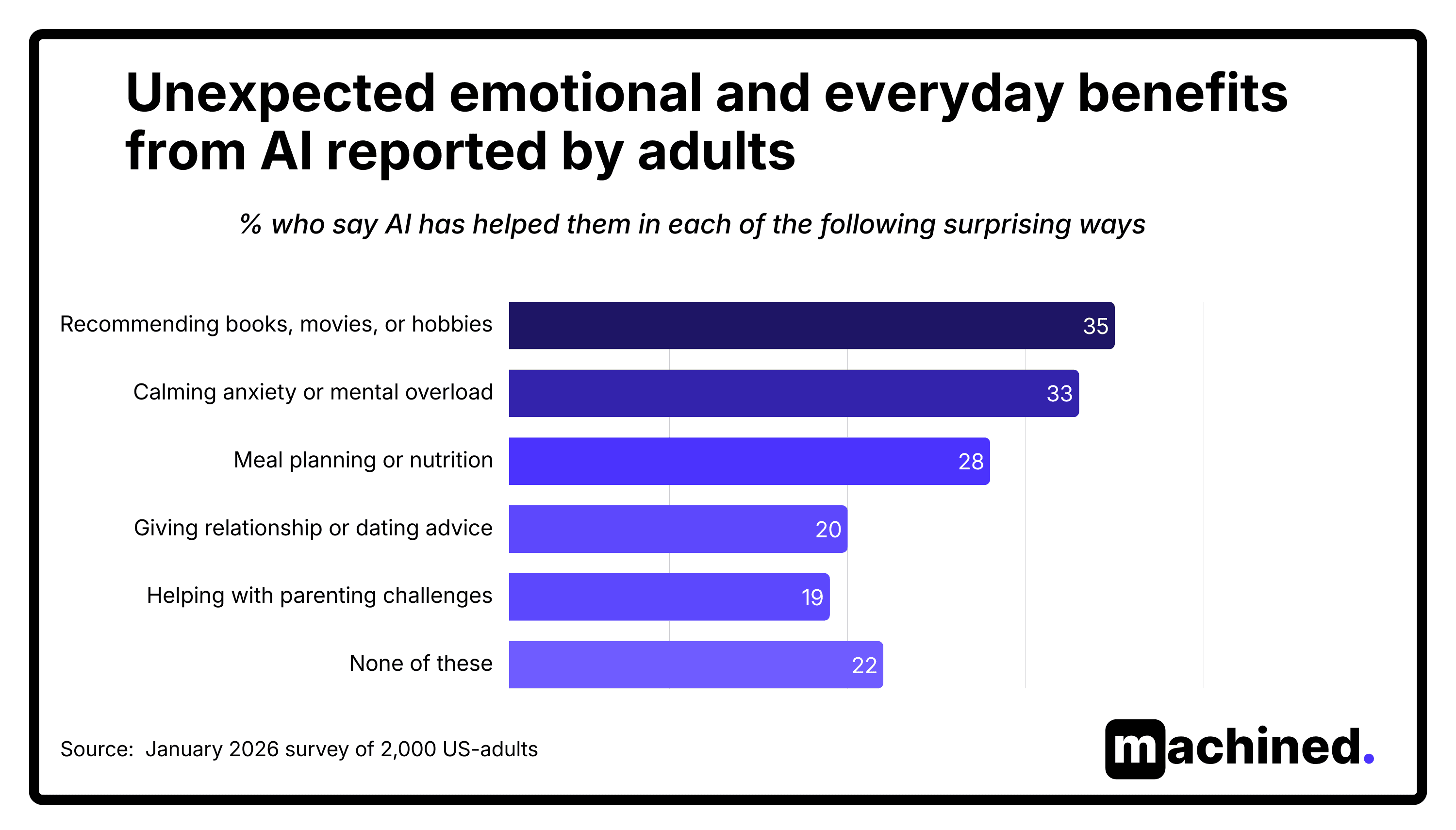
A recent study from the National Bureau of Economic Research found that more than 70% of AI usage is personal rather than professional. Our data align with this finding. When asked about unexpected ways AI has helped them, respondents point to applications that extend well beyond the workplace.
More than a third (35%) use AI for personalized recommendations: books, movies, and hobbies based on their existing interests. Thirty-three percent have used AI to calm anxiety or cope with mental overload, a figure that rises to 44% among Gen Zers. Twenty-eight percent use AI for meal planning and nutrition guidance. Twenty percent have sought relationship or dating advice from AI, and 19% have used it for parenting challenges.
Learning More, or Leaning on It?
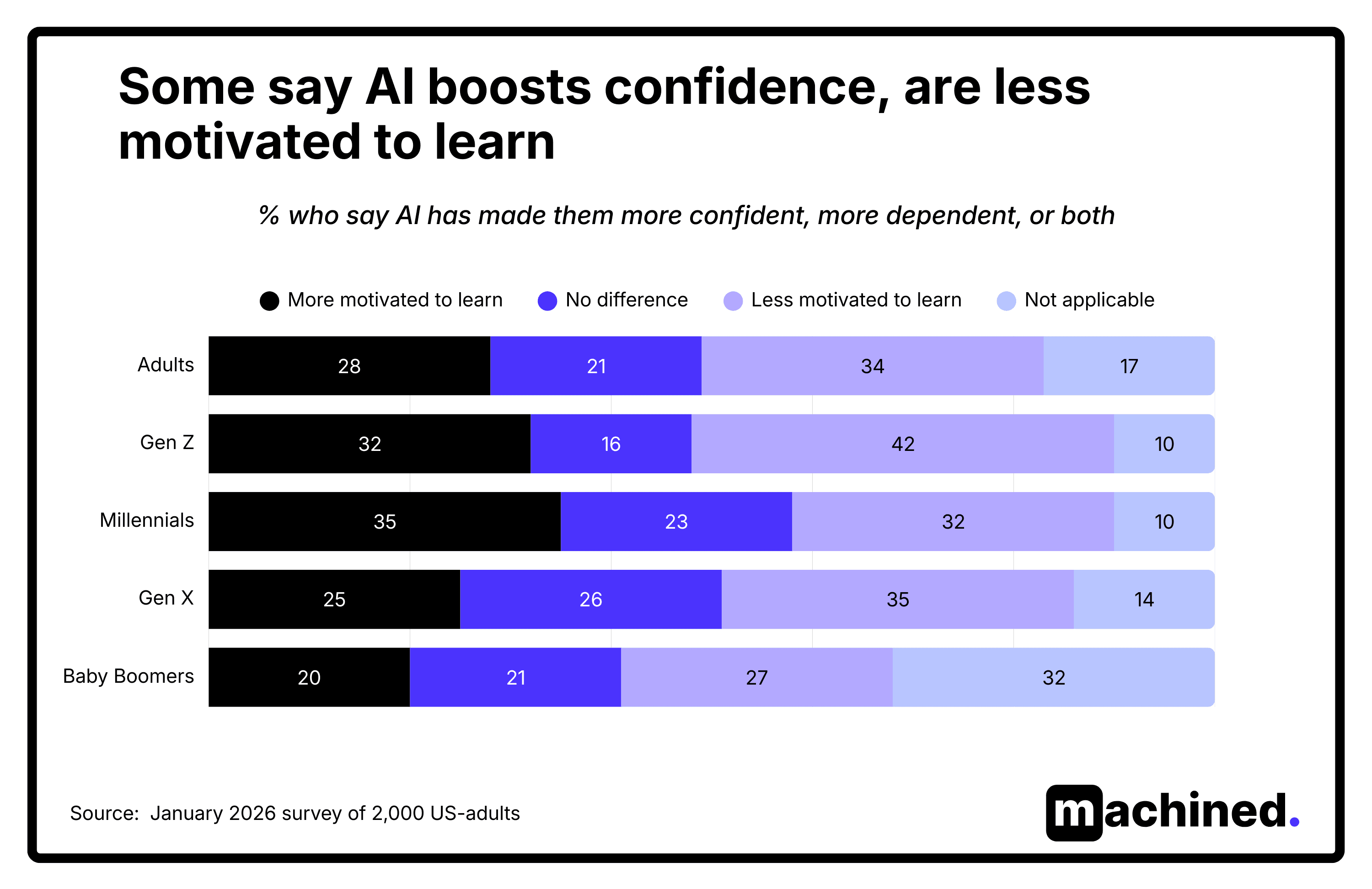
One of the most common concerns about AI is that it will reduce people's motivation to learn and think for themselves. The self-reported data offer a more optimistic picture, though with important caveats. When asked how AI affects their motivation to learn, 44% say it makes them more motivated, while 13% say it makes them less motivated. Thirty-four percent say it makes no difference.
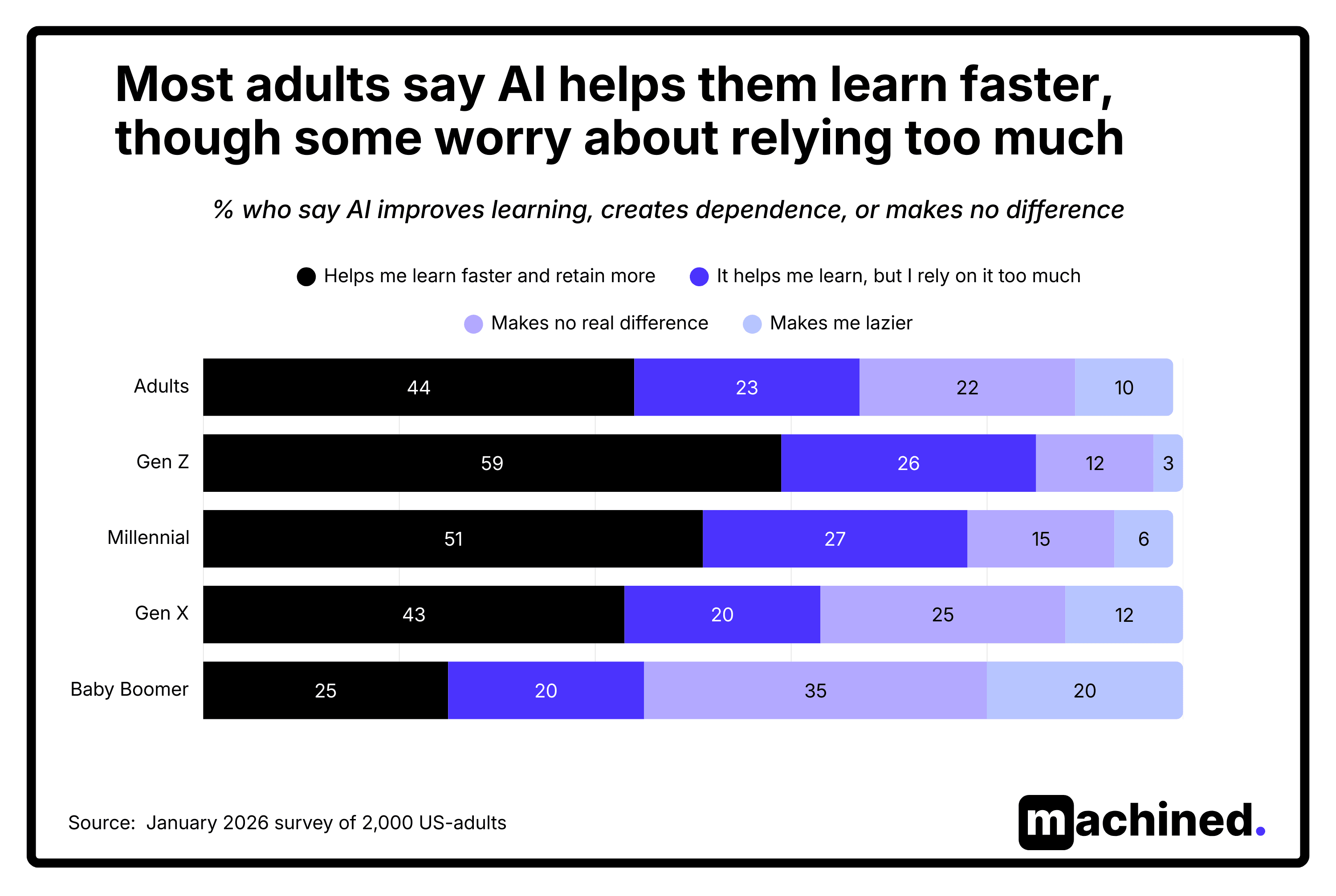
On the topic of AI's effect on their intelligence, 44% say AI helps them learn faster and retain more. Another 23% acknowledge they learn more, but may rely on it too much. Just 10% say AI makes them lazier or less likely to think for themselves. It is worth noting that self-assessments of learning and retention may not reflect actual cognitive outcomes, a question that warrants further research.
When we asked Americans to rank what has helped them learn or grow most in the past year, AI tools came in second only to YouTube and video tutorials. Twenty-seven percent ranked AI as their most helpful learning resource, behind YouTube (38%) but ahead of online courses (17%), podcasts and audiobooks (10%), and other social media (8%).
Who's Buying In
Adoption and perceived benefits vary significantly by age. Eighty-one percent of Gen Zers have used AI to learn or understand something new in the past year, compared to 75% of millennials, 57% of Gen Xers, and 39% of baby boomers.
Across nearly every metric, Gen Zers report the highest gains in confidence, capability, and motivation. They are most likely to report being surprised by what they can accomplish (70%), most likely to feel less embarrassed asking questions (48%), and most likely to say AI makes them more motivated to learn (55%).
Whether these self-reported gains translate into durable skills and knowledge – or whether younger users are simply more enthusiastic about new technology – remains to be seen.
The Other Side: Dependency and Concerns
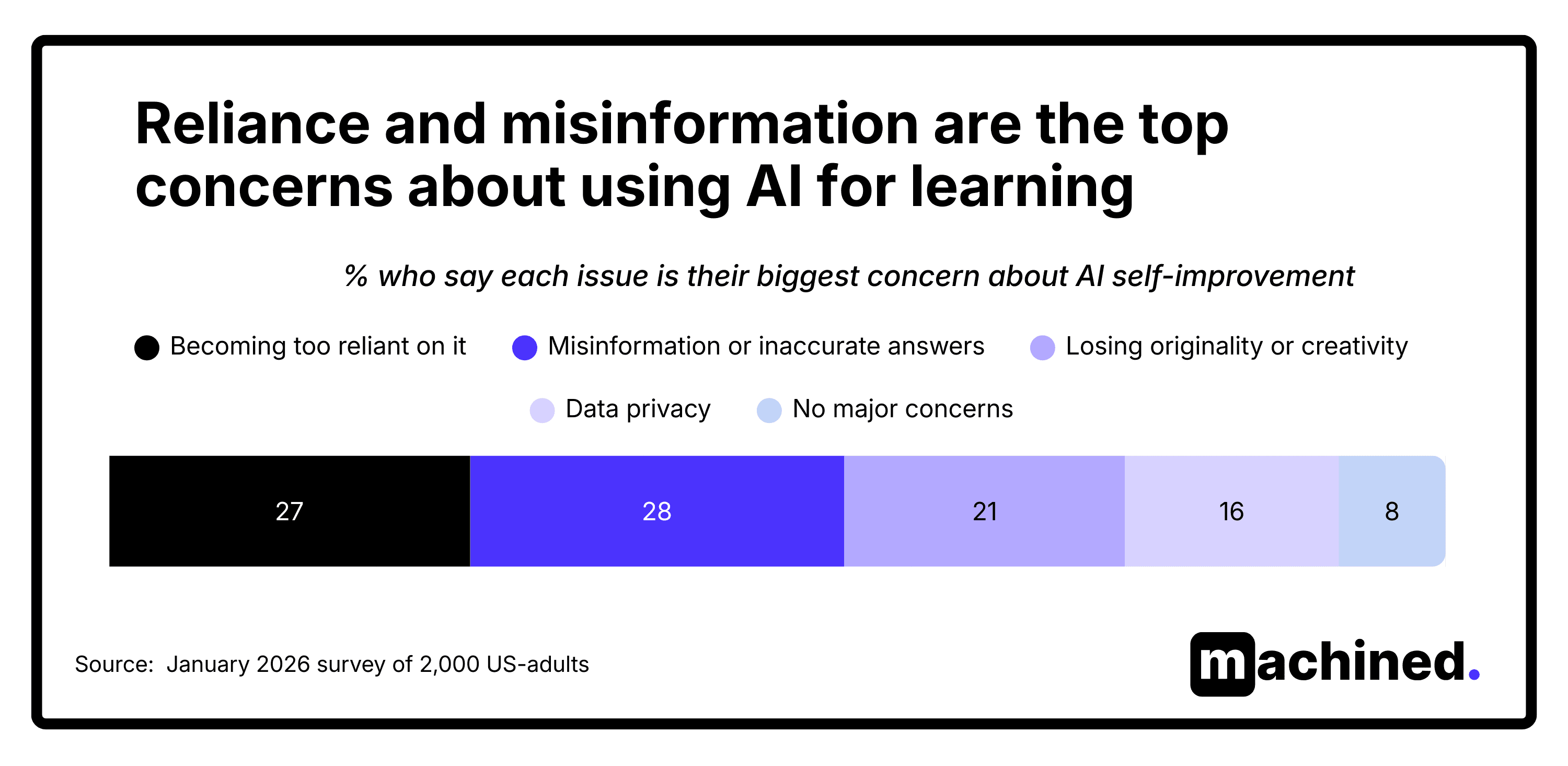
For all the reported benefits, Americans are far from uncritical. When asked about their biggest concerns around using AI for self-improvement and learning, misinformation and inaccurate answers topped the list at 28%. Close behind, 27% worry about becoming too reliant on AI, and 21% are concerned about losing originality and creativity. Data privacy concerns account for 16% of respondents. Just 8% say they have no major concerns.
The relationship between confidence and dependency is particularly complex. While 28% say AI has made them more confident in their abilities, 21% say it has made them more reliant on technology. Notably, 34% say both are true: they feel more confident and more dependent. This suggests that for many users, AI's perceived benefits come with a recognized trade-off – and whether the confidence is warranted or the dependency is problematic may only become clear over time.
Looking ahead, Americans are split on AI's long-term impact on future generations. While 27% believe AI will make the next generation smarter and more capable, 25% worry it will weaken their critical thinking skills. Another 31% expect a mix of both outcomes, and 17% say it is too early to tell.
Thirty-three percent of respondents say AI sometimes makes them feel overwhelmed or uncertain about the future, a sentiment that peaks among Gen Xers (36%) and millennials (33%), rather than the youngest generation.
Methodology
This survey was conducted in January 2026 among 2,000 American adults ranging in age from 18 to 77. Respondents were composed of a nationally representative panel. Participants answered a mix of multiple-choice and select-all-that-apply questions about their AI usage, attitudes toward learning and self-improvement, and perceived effects on confidence and capability. Percentages are rounded to the nearest whole number.
Fair Use
This data may be cited for non-commercial purposes with attribution. If you use these findings or any accompanying visuals, please link back to this page as the original source.
Ben Treanor, contributor to Machined.ai