
Familiarity is the Con: Why America’s Most Trusted Celebrities Make the Best Deepfakes
Deepfake fraud cost victims an estimated $2.19 billion globally last year and $712 million in the United States alone, according to an analysis by Surfshark, and on May 18, 2026, YouTube expanded its AI likeness detection tool to all adults 18 and over.
But ask most people whether they could be fooled by a fake video of a celebrity, and they'll tell you no chance. They'd spot the weird blinking, the lips that lag the audio, the voice that sits a half-second off. Then you show them a video of sweet Dolly Parton, warm and familiar, and their guard quickly drops.
Celebrity deepfakes have quietly crossed the line from novelty to everyday threat. The same generative tools that can clone a voice from a few seconds of audio or rebuild a face from a handful of photos are now cheap, fast, and good enough to fool people who are certain they'd never be fooled. What used to take a studio now takes an app and a few minutes, and scammers are taking advantage.
One of the most widely reported cases of a celebrity deepfake involved a French interior designer in her early fifties who was targeted by fraudsters posing as Brad Pitt. The scheme began in 2023 when a fake account claiming to be a member of Pitt's family initiated contact on Instagram, gradually drawing the victim into what she believed was a genuine romantic relationship. Over more than a year, scammers sent AI-generated images and fabricated a story about medical expenses Pitt supposedly couldn't cover due to his divorce. The woman transferred approximately €830,000 before discovering the fraud. Pitt's representatives later urged fans to treat all unsolicited online contact from apparent public figures with extreme skepticism.
To give us all a clearer sense of when to pause and verify, Machined.ai surveyed 2,000 U.S. adults to find out which celebrities Americans trust so instinctively that a deepfake video of them could slip right past, then turned those rankings into America's Deepfake Trust Index, a study of 240 public figures across six categories. The Index reads less like a popularity contest and more like a map of risk, indexing the faces and personalities worth the most to a fraudster so people can see where their own blind spots are before someone else finds them first.
Each figure earned a score out of five, averaging how much Americans said they'd trust a video of them. A higher number means a more trusted face, and a more valuable one to bad actors.
Key Takeaways:
- Tom Hanks is America's most trusted celebrity, making his face perhaps the one to be most weary of
- Legacy actors Dolly Parton, Morgan Freeman, Denzel Washington, and Keanu Reeves follow closely behind
- Fewer than half of Americans (42%) feel confident they can spot a celebrity deepfake video
- 7% of Americans say they have already been scammed by a deepfake, and 27% of those victims lost $1,000 or more
- Adults 65 and older are victims of scams at twice the rate of adults 18-24
Tom Hanks, Dolly Parton and Morgan Freeman — the celebrities topping America's deepfake vulnerability list
The more you trust someone, the less likely you are to pause before acting on what they appear to say. That pause, or the absence of it, is where deepfake fraud lives.
What connects our most trusted public figures is a particular kind of credibility built over decades. These are figures Americans have watched for years without cause for distrust, people who feel, by now, almost like someone you know. That familiarity is exactly what makes their faces valuable to a fraudster.
The least trusted figures in the study were Kanye West and Jake Paul, each scoring 1.74, followed by IShowSpeed at 1.88, Logan Paul at 1.95, and Mark Zuckerberg at 1.96. Americans already approach these figures with skepticism, which limits their usefulness to scammers.
The most trusted face in every state, from Dolly Parton to Lester Holt
But when it comes to the familiar faces we wouldn't even question, two names do most of the heavy lifting. Dolly Parton is the top pick in 14 states and Tom Hanks in another 14, with Morgan Freeman leading in ten.
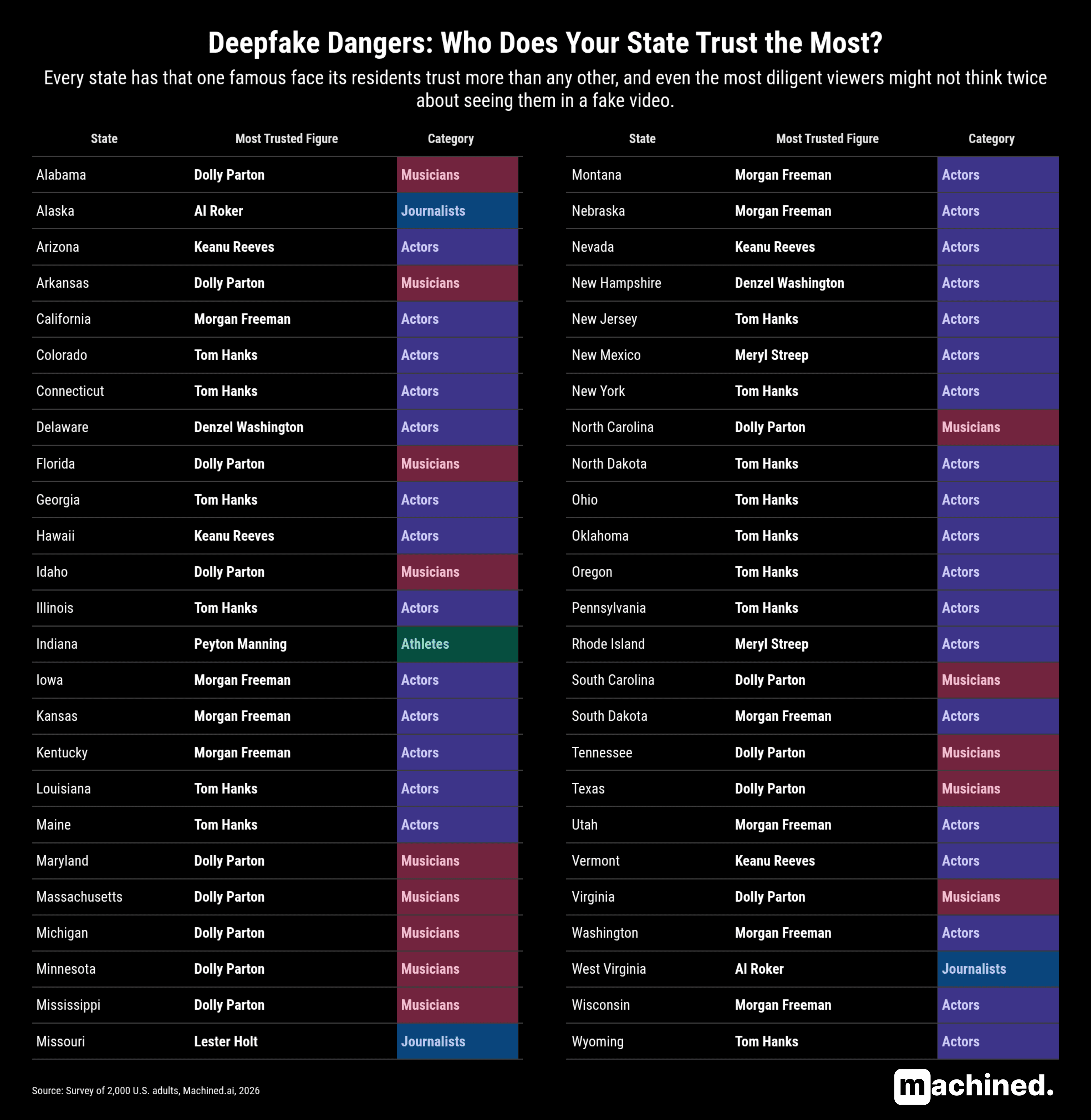
A handful of states go their own way. Meryl Streep is the runaway favorite in New Mexico, and unsurprisingly local hero Peyton Manning in Indiana. Vermont trusts Keanu Reeves most, and Missouri lands on news anchor Lester Holt. So be diligent. Whoever tops your state's list is also the face a scammer would have the easiest time hiding behind a deepfake video.
Adults over 65 are the most vulnerable to celebrity deepfakes, and the least able to keep pace with the tech
The clearest vulnerability in the data is age. Adults 65 and older report a deepfake scam rate of 14.2%, more than double the 6.7% rate among 18 to 24-year-olds, and FBI and FTC data consistently show adults over 60 carry the highest median losses from online fraud. They are also the least confident they could catch a fake in the first place: just 30% feel very or extremely sure they could spot a deepfake video, against 42% of Americans overall.
Deepfakes have improved enormously in a very short window, and the tools to make them are now cheap and everywhere. Keeping track of how convincing and how common they have become is harder for people who did not grow up online and do not spend their days inside the platforms where fakes spread fastest. A clip that a younger viewer might instinctively second-guess can read as perfectly ordinary to someone who has not seen how far the technology has moved.
The faces involved make it harder still. The figures at the very top of the Index, Tom Hanks, Dolly Parton, and Morgan Freeman, now in his late 80s, are stars older Americans have watched and trusted across entire lifetimes. Decades of goodwill do not switch off because the medium changed, and the trust the Index measures runs deepest exactly where the data says it is most exploitable. Audio raises the stakes again: only 32% of Americans feel confident spotting a cloned voice, the kind increasingly used in phone-call and voice-note scams aimed at older targets.
Luckily, many celebrities are on our side, and doing their part to fight against this new era of deepfakes. Morgan Freeman — voted America's most wanted AI voice assistant — has spent the past year sending lawyers after anyone who tries to clone his voice without consent, while British legend David Attenborough has called the process "profoundly disturbing". Other celebrities including Scarlett Johansson, Matthew McConaughey, and Tom Hanks have also been firm in their stance on AI voice cloning.
Younger men sit at the other end of the spectrum. Seven in ten men aged 18 to 24 say they could spot a celebrity deepfake, the most confident group in the survey.
1 in 20 Americans has lost money to a deepfake, and 27% of victims lost $1,000 or more
The trust is abstract until the money isn't. One in 20 American adults, as many as 14 million overall, have been personally scammed by a deepfake video or audio clip, and another 10.5% know someone who has. For these people, this is not a looming risk; it is a bill that has sadly already come due.
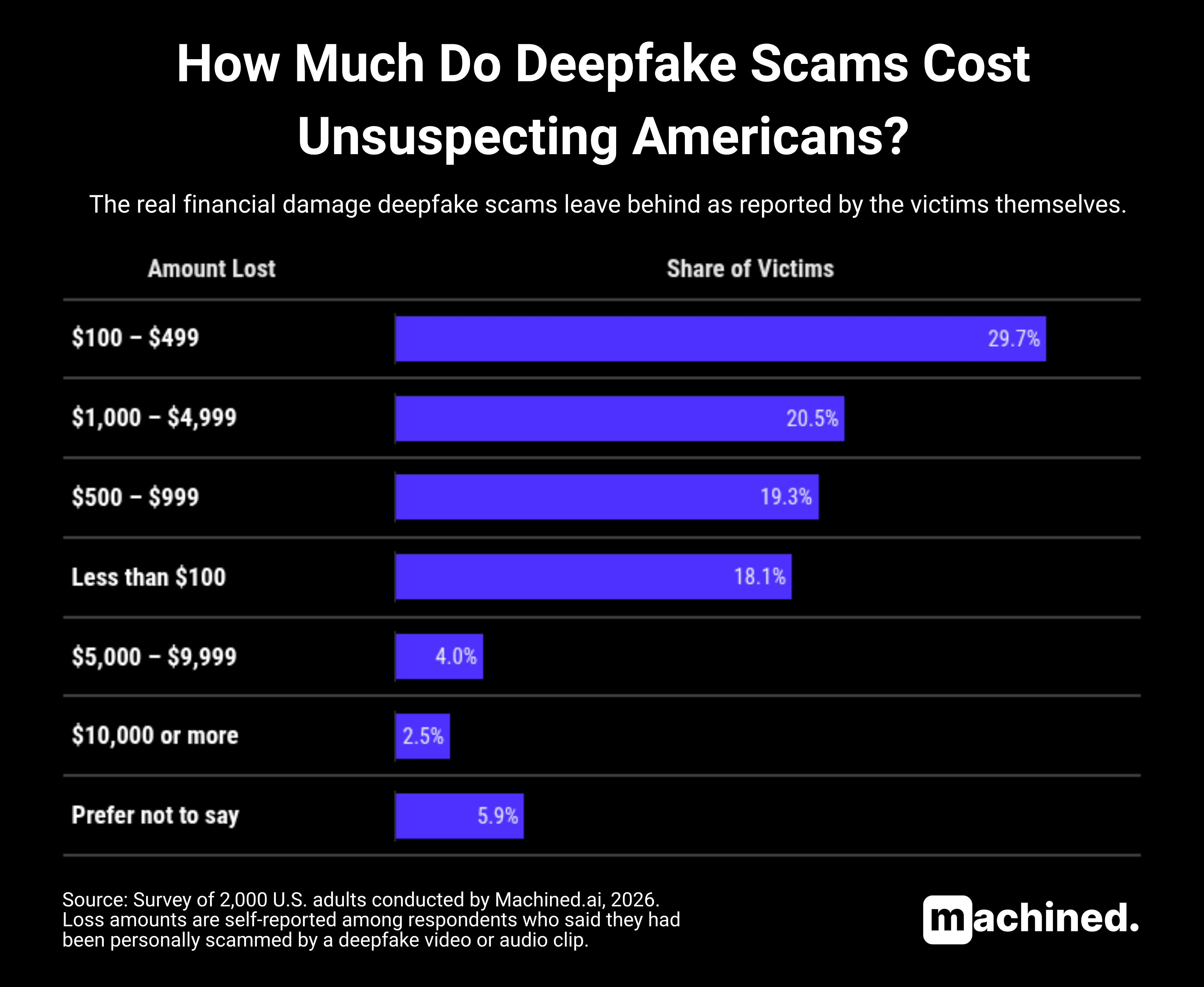
Most losses were relatively modest, with the most common bracket being $100 to $499, reported by 29.7% of victims, in line with the $525 average loss in McAfee's 2025 Deepfake Deception List. On the high end, 27% of victims lost $1,000 or more, and 6.5% lost upwards of $5,000.
How to keep a celebrity deepfake from fooling you
The threat is no longer limited to pre-recorded clips stitched together from public footage. By early 2026, security researchers at Malwarebytes identified industrial-scale operations run out of scam compounds in Southeast Asia where human operators use real-time deepfake face-swapping software to conduct live video calls with their targets. The person on the other end of the call appears to be a celebrity, a love interest, or a trusted figure, and they respond in real time to questions, laugh at jokes, and build rapport over weeks or months.
You cannot un-trust Tom Hanks, and you shouldn't have to — he's America's dad, after all. The goal is not suspicion of everyone you admire; it is a few small habits that catch a fake before it costs you anything. These five do most of the work.
- Make checking the default, not the exception. Only about one in four people verify whether a video is real before acting on a trusted endorsement. Flip that for yourself. Before you buy, donate, or share, treat "is this actually real?" as the first question, not an afterthought.
- Treat urgency as a warning sign. Almost every scam runs on pressure, a limited-time offer, a disaster appeal that needs money now, an investment window closing tonight. A genuine recommendation can wait ten minutes while you check. A scam usually cannot.
- Do not give audio a free pass. Just 32% of Americans feel confident spotting a fake audio clip, well below the 42% who feel confident with video, and a familiar voice on a phone call or voice note is now easy to clone. Hearing someone you recognise is not proof it is them.
- Confirm through a second channel you already trust. If a video points you somewhere, do not act inside the app that served it to you. Go directly to the person or organisation through their official website, verified account, or a phone number you already have, and confirm the offer exists.
- Raise your guard for the faces you love most, not lower it. Your favourite celebrities are exactly the ones scammers are most likely to deepfake, because their credibility does the persuading for free. Visual tells like lip-sync lag, odd blinking, and inconsistent lighting can still help, but detection tools are improving fast, so the safest move is to verify the source rather than trust your own eye.
Methodology
This study was conducted in May 2026 by Machined. It surveyed 2,000 U.S. adults aged 18 and over through an online panel, nationally representative for each state. Each respondent rated a randomised subset of public figures, drawn from a pool of 240 across six categories, on two trust dimensions: endorsement trust and personal statement trust. All trust ratings were collected before any mention of deepfakes to avoid priming bias, with deepfake detection confidence, scam experience, and behavioural questions measured in a separate second phase.
Fair Use
Want to share what you've found here? Go for it. You can use our data and graphics for non-commercial projects; just add a link to this page as attribution when you do so.
Ben Treanor, contributor to Machined.ai