

GEO vs SEO: Why GEO Isn't a New Strategy
A few days ago, I was talking to my dad about running Machined. I had written a journal entry about what I'd been focusing on: churn, customer value, and growth. He read it and shared a story from his days in charge of a brick-and-mortar business.
"We had a churn problem," he said. "So we started sending a regular newsletter to show customers the value we were adding." Light bulb moment. "But we also had a visibility problem. We needed new customers. Once we plugged the leaky bucket, we raised our profile. We invested in radio ads." Second light bulb moment.
I looked at my own work and saw the same pattern. I had just built a new email onboarding campaign (our digital newsletter), added a couple of in-demand features (adding value for our users), and increased publishing on this blog (SEO killed the radio star). Same formula. Different mediums.
That conversation stuck with me because I see the same dynamic in the SEO industry right now. Everyone's talking about GEO (Generative Engine Optimization) as if it demands new skills, new tools, and an entirely new playbook. I don't see it that way. I see the same strategy at work in a new context.
Everyone's talking about GEO (Generative Engine Optimization) as if it demands new skills, new tools, and an entirely new playbook. I don't see it that way. I see the same strategy at work in a new context.
The 80/20 of Search
Here's how I frame it: fundamentals drive about 80% of your results. You need content that answers real questions. You need backlinks from trusted sources. You need basic technical foundations. This has held true for years.
The GEO-specific layer, such as formatting for AI citations, appearing in ChatGPT results, and optimizing for Perplexity, makes up the other 20%, at most. If you obsess over that 20% while the fundamentals are weak, you've flipped your priorities.
I watch people panic about GEO. They buy new tools and invest in learning "new disciplines," all while their content isn't good enough to rank anywhere. Fix the 80% first. We've written more about the fundamentals of SEO here.
The Numbers Don't Justify the Panic
Let's look at where we actually stand.
Google still controls roughly 90% of the global search market. That share has dipped slightly, but Google still dominates amongst search engines.
AI search is growing fast. For example, ChatGPT's share of general queries grew to 17% in 2025.
But AI platforms still drive less than 1% of actual web traffic. Let me repeat that: less than one percent.
Google processes around 15 billion searches every day. ChatGPT sees about 5.7 billion visits per month. Google does in one day 3x what ChatGPT does in a month.
Should you ignore AI search? No. It's growing, and it matters. But treating it as something that requires a completely different strategy, when it still represents a tiny fraction of your traffic doesn't make sense.
AI platforms also don't focus on sending users to websites. Bernard Huang makes this point clearly:
And he's right. These systems try to directly answer questions, not act as referral engines. So why would you optimize exclusively for a surface that tries to be self-contained?
Machined Ranked in AI Results Without Trying
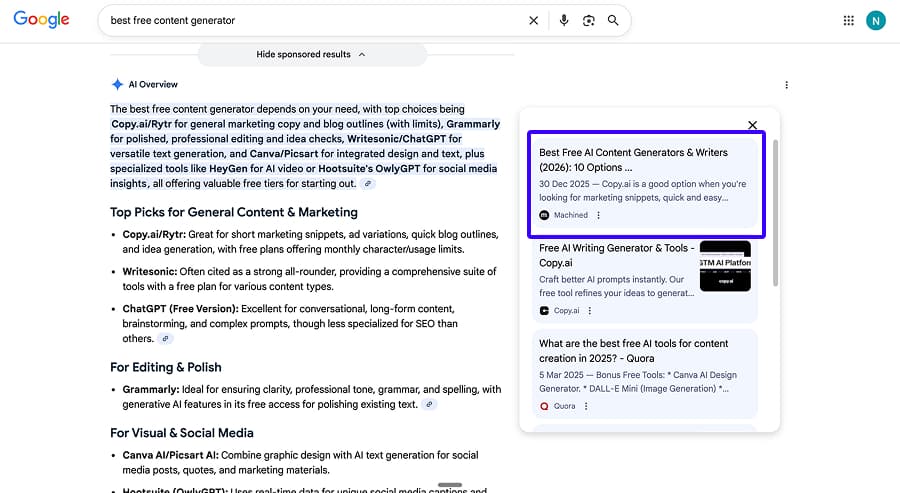
Although purely anecdotal, here's what helped convince me more than any statistic.
Last week, we wrote and published an article on the best free AI content tools. I didn't think about AI. I didn't optimize for citations. I didn't purposefully structure it for LLMs or chase snippet-friendly formatting. I focused on writing something useful for people searching for that topic.
That article now holds the top ranking position in AI search results.
I didn't run a GEO strategy. I applied SEO fundamentals. AI picked it up anyway, because both systems have the same goal: deliver the best answer to a query.
The Arguments for GEO (And Why I'm Skeptical)
Let's walk through the common arguments for why GEO is "different."
"GEO is a new discipline that requires new skills"
I don't buy that. The basics haven't changed: create valuable content, build authority, keep your site technically sound.
Yes, new surfaces exist. ChatGPT, Perplexity, and AI Overviews in Google now display content in new ways. But those systems still surface the same content that performs well in traditional search. The end goal remains the same: find useful answers.
Maybe I'm wrong. It's a strong opinion that could change. But I haven't seen evidence that you need a fundamentally different skill set for GEO.
"You need to optimize for citations, not rankings"
Who gets cited? The article sitting in position 20?
AI systems still need a way to judge value. I don't know exactly how every LLM makes those decisions, but I'd bet they use the same criteria that drive traditional rankings: authority, relevance, quality.
If your content can't compete in search, it probably won't earn citations either.
"AI search is killing click-through rates"
This one's real, but it's not new.
Zero-click searches existed long before AI. Years ago, I worked at a company where our ranking position stayed the same, but our link dropped 400 pixels down the page compared to a few years earlier. Google had added rich snippets, knowledge panels, and "People also ask" boxes. We held the same rank, but we were buried under Google's new features.
That wasn't AI. That was Google improving the user search experience. And now, that's AI's goal as well.
I understand the frustration. Creating content and watching AI platforms or Google surface it without sending traffic back hurts. But this shift reflects an evolving ecosystem, not an AI-specific problem.
The traffic that remains usually shows stronger intent anyway, as much as 3x more likely to convert. AI answers top-of-funnel questions directly, but people still click when they want to buy, sign up, or book. The visitors that filter through now are further down the funnel, making conversion easier.
"Content needs to be structured differently for AI"
Maybe. Lists do help AI with extraction (even our article above is a small example of this). Question-based headers can make parsing easier. Snippet-friendly formatting might make a difference in presentation.
But those structures also help readers. If a list fits the content, use one. If it doesn't, don't force it just because "AI likes lists."
I see this in a different context but I think the learning is the same: with AI generated content lots of people are trying to "humanize text" by adding awkward phrasing and intentional errors to fool AI detectors. The resulting content often becomes unreadable. They're optimizing for detection instead of usefulness.
The takeaway? In both cases: write for the human who reads the content. Use lists when they clarify. Write long-form when depth matters. Don't pad 2,000 words before giving the secret sauce just to chase rankings. Readers want the goods, not the filler.
Short-term tactics come and go, but people always lose when you optimize for algorithms instead of readers.
"Brand mentions matter more than links now"
This argument claims that LLMs learn from text across the web, so frequent brand mentions, even without links, drive citations.
But I see mentions and links as the same signal in different forms. Both represent social proof and endorsement.
Links give us a measurable version of that signal. If AI can understand context, sentiment, and whether a mention is positive or negative, it's just reading endorsement through text instead.
This brings us back to fundamentals. For example, if you run a legitimate link building strategy such as a digital PR campaign, create content that journalists want to cite, and get it in front of the right audiences, you'll get links and brand mentions together.
If instead, you buy low-quality links on irrelevant websites, AI will spot that, just as Google eventually does.
Search Everywhere Optimization
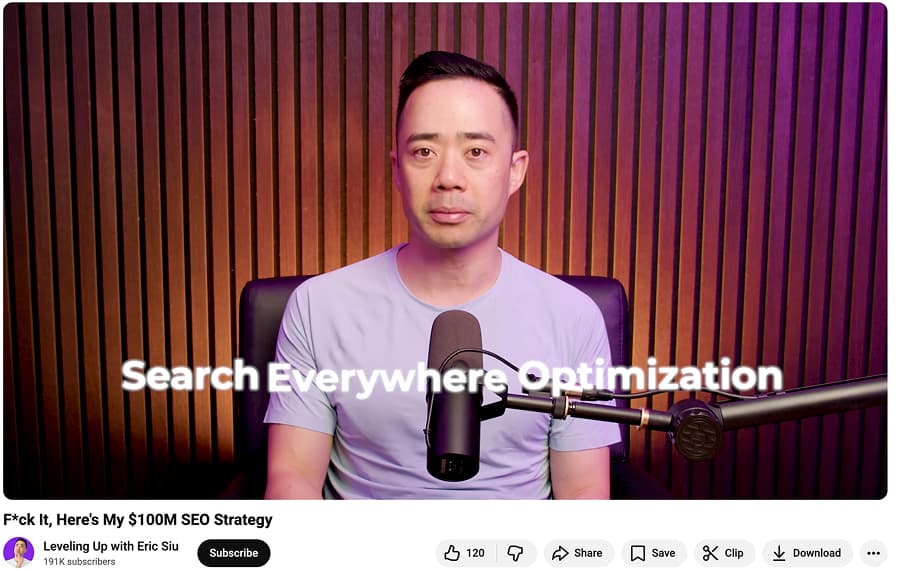
Watch the full video here.
Eric Siu, CEO of Single Grain, uses the phrase "Search Everywhere Optimization" to describe how people now search across platforms: Google, YouTube, TikTok, ChatGPT, Amazon, Reddit.
I agree with him about the landscape. Search is fragmenting, but I see the strategy converging, even as the platforms diverge.
On every platform, useful content wins. YouTube rewards videos that keep people watching. Reddit surfaces answers that the community values. ChatGPT cites sources that answer questions well.
The surfaces differ. The underlying principle stays the same: be useful, be findable, be trustworthy.
You don't need a new strategy for each platform. You need solid fundamentals that translate everywhere.
Google and AI Have the Same Incentive
This is what I keep coming back to: Google and AI operate on the same incentive.
Google succeeds when it delivers useful results. If users lose trust in those results, they stop searching and Google's revenue drops. Every algorithm update, every change to the search results, they all have one goal: improve the user experience.
This might be the most contentious opinion in this article, as many people would argue that Google is just trying to make money. And while I agree that is true, nothing will lose Google money faster than becoming bad at search, which is why I think they will always be optimizing to make the search experience better.
AI works the same way. If ChatGPT gives bad answers, people switch tools. The incentive is identical: usefulness keeps users loyal.
So when you ask how to optimize for AI, you get the same answer you already have for Google. Help people. Build authority in your space. Make your site work well.
The systems differ. The surfaces differ. But the incentive structure stays the same. That's why the strategy stays the same.
Strong Opinions, Loosely Held
I might be wrong. In a few years, GEO might become its own discipline with its own rules. Maybe the tactics that work for AI search will diverge significantly from those that dominate traditional SEO.
But right now, I see the same fundamentals driving results: good content, authority, and solid technical foundations. Do those well, and you'll show up in Google, in ChatGPT, and in whatever comes next.
The medium changes. The formula doesn't.
Don't let the noise around GEO distract you from the 80% that actually moves the needle.
And remember, my goal with these posts is to make SEO accessible, understandable, and to cut through the noise for those who might find the minefield that is SEO advice overwhelming.
There may be experienced SEO professionals who will already have optimized for the 80% and need those additional tips and tricks to get the incremental gain, but for the large majority of people that isn't the case.
About the Author

Nick Wallace
AuthorLong time SEO professional with experience across content writing, in-house SEO, consulting, technical SEO, and affiliate content since 2016.