AI SEO
11 Best AI Visibility Checkers (Free and Paid)
We compared 11 AI visibility checkers on price, engines covered, prompt limits and free access. Here is which one fits your site, budget and stage.
· Noa Vernick, AI Visibility Specialist, Arobis AI
Someone asks ChatGPT for the best tool in your category. It names three brands. Are you one of them? A year ago almost nobody could answer that question. Now there are dozens of tools that promise to, with prices that run from free to “contact sales”.
A note on who’s writing this. This is a guest post by Noa Vernick, AI Visibility Specialist at Arobis AI. Arobis AI makes the first tool on this list, the free Arobis AI Visibility Checker, and Machined.ai makes the fourth.
The Machined.ai team has been clear on this: GEO sits on top of SEO fundamentals, it does not replace them. Good content, real links and a clean technical setup still do most of the work. But you cannot improve what you never measure, and an AI visibility checker is how you find out whether that top layer is working.
So we went through the market and picked the 11 checkers worth your time, with pricing taken straight from each vendor’s own page.
TL;DR: the quick picks
- Best free starting point: the Arobis AI Visibility Checker. No signup, a score out of 100 in about 25 seconds, and a list of the fixes that matter.
- Best if you already live in an SEO suite: Semrush AI Visibility Toolkit ($99/mo) or Ahrefs Brand Radar (from $50/mo on top of a paid Ahrefs plan).
- Best cheap prompt trackers: Machined.ai (pay per check, about $4 a month for 10 weekly prompts on 3 engines), Otterly.AI (from $29/mo) or ZeroRank (from $39/mo across 17 AI platforms).
- Best for HubSpot teams: HubSpot AEO ($50/mo, $45 billed annually).
- Best value for volume: SE Visible (200 prompts from $99/mo).
- Best for enterprise: Profound or Scrunch.
What an AI visibility checker actually does
The term covers two different kinds of tool, and mixing them up is the most common buying mistake.
- Readiness checkers look at your own website. Can AI crawlers like GPTBot and ClaudeBot get in? Do you have structured data, a clear page structure, an llms.txt file? They answer “why might AI engines be leaving us out?” They are fast, repeatable and usually free.
- Prompt trackers send real questions to ChatGPT, Perplexity, Gemini, Google AI Overviews and others on a schedule, then record whether your brand is named, how it is described and which sources get cited. They answer “are we showing up, and is it changing?” They cost money because every prompt run costs the vendor money.
Most teams need the first before the second. There is little point paying to watch a number every day if a robots.txt rule is blocking half the engines from reading your site.
Why this matters now
- ChatGPT reached 900 million weekly active users in February 2026.
- Google’s AI Mode passed 1 billion monthly active users, according to Alphabet’s Q2 2026 earnings.
- In G2’s survey of 1,076 software buyers, 51% now start research with an AI chatbot more often than with Google, and 69% picked a different vendor than planned because of a chatbot recommendation.
Google is still the biggest source of search traffic by a wide margin, and Machined.ai’s study of 10,000 keywords shows how much AI Overviews already shape what people see on the results page. AI answers are no longer a side show. They are part of how buyers make a shortlist.
How we chose these tools
We judged every tool on the same six things:
- Free access: is there a free tool, free tier or trial, and do you need a card?
- Engines covered: ChatGPT, Gemini, Perplexity, Claude, Copilot, Google AI Overviews and AI Mode.
- Entry price and limits: what the cheapest plan costs and how many prompts it includes.
- Actionability: does it tell you what to fix, or only report a number?
- Data quality: live prompt runs versus estimates.
- Fit: who the tool is really built for.
Pricing changes often in this category. Every price below comes from the vendor’s own pricing page, so check it again before you buy.
Comparison at a glance
| Tool | Entry price | Prompts | Engines | Free access | Type |
|---|---|---|---|---|---|
| Arobis AI Visibility Checker | Free | n/a | ChatGPT, Gemini, Claude, Perplexity (readiness) | Free, no signup | Readiness checker |
| Semrush AI Visibility Toolkit | $99/mo | 25 | ChatGPT, AI Mode and others | Free checker, 3 a day | Prompt tracker plus research |
| HubSpot AEO | $50/mo ($45 annual) | 25 | 3 | Free trial, free one-time grader | Prompt tracker |
| Machined.ai | Pay per check (1c to 8c), about $4/mo to start | Up to 50 | 6 | No monthly minimum | Prompt tracker |
| Profound | Custom | Custom | Up to 9 | 7-day free trial | Prompt tracker |
| Peec AI | $95/mo ($80 annual) | 50 | 3 of your choice | Prompt tracker | |
| Otterly.AI | $29/mo ($25 annual) | 15 | 4, plus paid add-ons | Prompt tracker | |
| ZeroRank | From $39/mo | Unlimited (up to 2,400 answers/mo on Starter) | 17 | Full report before a card | Prompt tracker |
| SE Visible | $99/mo ($79 annual) | 200 | 5 | 10-day free trial | Prompt tracker |
| Scrunch | $250/mo | 125 | 4 | 7-day free trial | Prompt tracker |
| Ahrefs Brand Radar | From $50/mo, on a paid Ahrefs plan | Custom, plus a 490M+ prompt database | 6 | Prompt database |
1. Arobis AI Visibility Checker: best free starting point
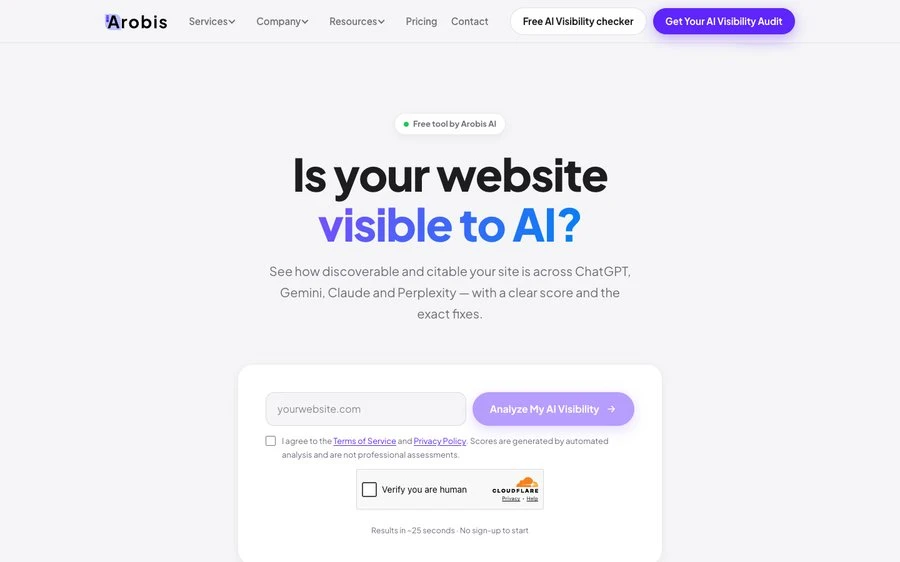
Arobis AI is an AI search demand generation agency for B2B SaaS, and its free AI Visibility Checker is the quickest way to see how ready your site is for AI engines. You type in a domain, and about 25 seconds later you get an AI Visibility Score out of 100 with a breakdown of what is holding you back. No account, no card.
The score is built from six weighted signal groups: AI crawler access (25%), structured data (20%), semantic structure (20%), content and entity signals (15%), llms.txt (10%) and technical health (10%). You also get a separate readiness estimate for ChatGPT, Gemini, Claude and Perplexity, a shareable report link, and a prioritised fix plan. More than 2,300 websites have been checked so far.
What we like most is the weighting. It tells you where a fix moves the needle, which is far more useful than a list of 40 equal warnings. If a crawler is blocked in robots.txt, that jumps straight to the top.
- Price: free.
- Engines: ChatGPT, Gemini, Claude, Perplexity (readiness estimates).
- Best for: any site that wants a clear baseline before spending money on tracking.
- Watch out for: it is a readiness checker, not a prompt tracker. Scores come from your site’s signals, not live questions to each model, and the full fix plan sits behind a short contact form.
2. Semrush AI Visibility Toolkit: best for Semrush users
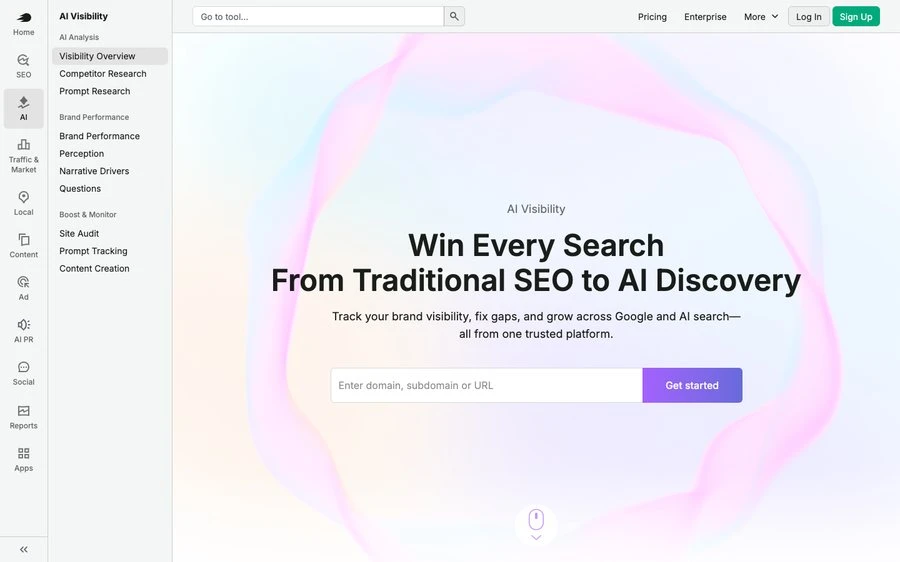
Semrush, now owned by Adobe after a deal that closed in April 2026, has built AI visibility into its platform. The AI Visibility Toolkit costs $99 a month and includes 25 tracked prompts. Its standout feature is Prompt Research, which gives prompts keyword-style volume and difficulty data, while Prompt Tracking covers more than 220 countries and territories.
There is also a free AI search visibility checker that covers ChatGPT, Gemini, AI Mode and AI Overviews, three times a day without registering.
- Price: $99/mo for the toolkit. Semrush One Starter bundles it at $199/mo ($165.17 billed annually) with 50 prompts.
- Engines: Google AI Mode, ChatGPT and others in tracking. The free checker covers four AI surfaces.
- Best for: teams already paying for Semrush.
- Watch out for: no free trial on the toolkit, and each extra domain or user adds another $99.
3. HubSpot AEO: best for HubSpot teams on a budget
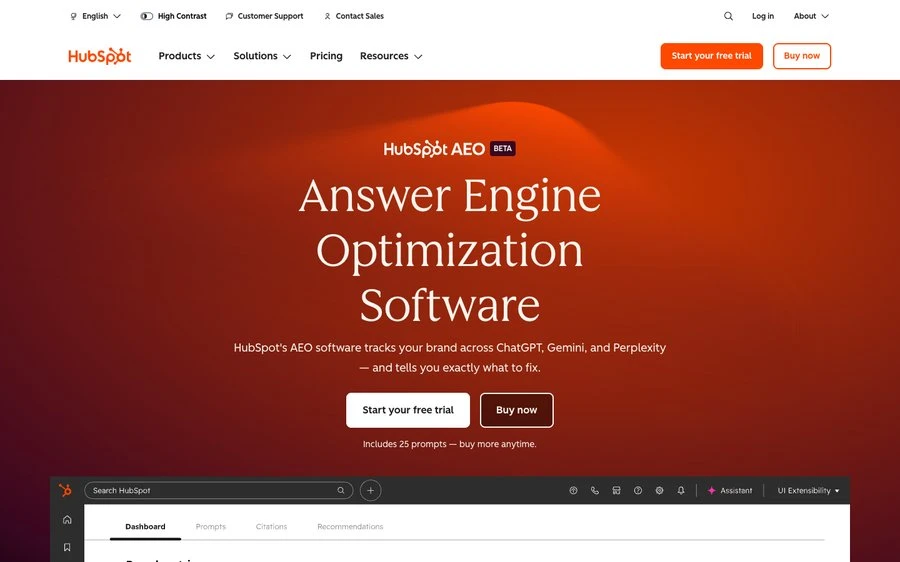
HubSpot AEO tracks your brand across ChatGPT, Perplexity and Gemini for $50 a month ($45 if you pay annually), with 25 prompts. Its smartest touch is that it suggests prompts to track based on your company, competitors and industry, so you start from real context instead of guesses. On Marketing Hub Pro and Enterprise it also draws on your CRM data, which makes its recommendations more specific.
There is a free trial with no credit card, and a separate free AI Search Grader for a one-time check, which HubSpot says is based on the models’ training data. A short form unlocks the full report.
- Price: $50/mo, $45/mo billed annually.
- Engines: ChatGPT, Perplexity, Gemini.
- Best for: small and mid-size teams already on HubSpot.
- Watch out for: only three engines, CRM-powered recommendations need Marketing Hub Pro or Enterprise, and the free grader is a one-time check.
4. Machined.ai: cheapest way to start tracking prompts
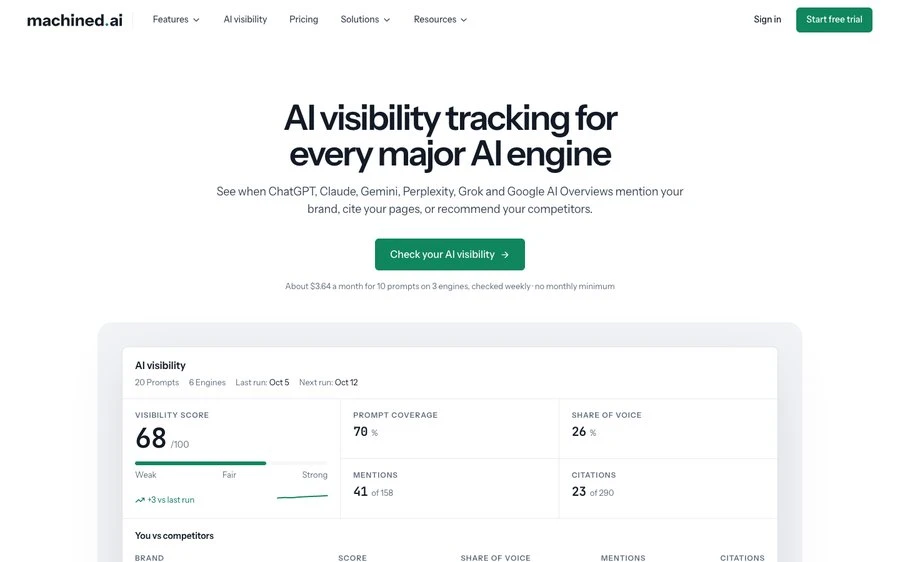
Machined.ai prices prompt tracking per check instead of per month. One check is one prompt on one engine, paid from prepaid credit: from 1c on Google AI Overviews to 8c on Grok. Ten prompts on AI Overviews, ChatGPT and Claude, checked weekly, comes to about $3.64 a month. There is no monthly minimum, and you do not need a Machined.ai content plan.
Each run saves every engine’s full answer, records whether you were mentioned and in what position, and tracks citations separately. Competitors are tracked free alongside you.
- Price: pay per check, 1c to 8c. Around $4/mo for 10 weekly prompts on 3 engines.
- Engines: ChatGPT, Claude, Gemini, Perplexity, Grok, Google AI Overviews.
- Best for: small teams that want to start tracking without a monthly subscription.
- Watch out for: the cost grows with prompts, engines and frequency (50 prompts on all six engines, checked daily, is about $345 a month), and there is a 50-prompt cap. It suits weekly or monthly checks better than daily ones.
5. Profound: best for large enterprises
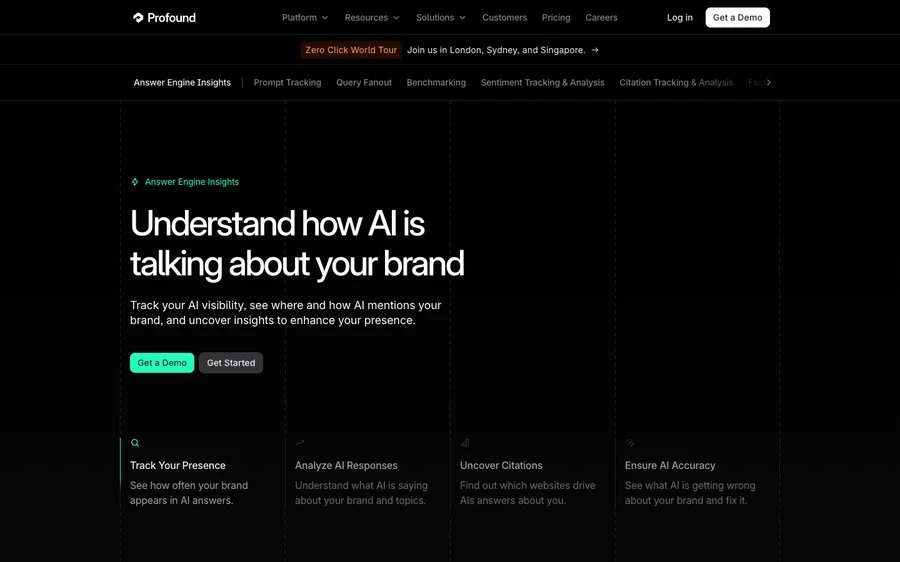
Profound is one of the best-funded names in the category and is built for big brands. It tracks up to nine engines on the Enterprise plan, includes an AI Marketer agent, and offers the security features large companies ask for, such as SSO/SAML and SOC 2.
You can test it with a free 7-day trial that runs 50 prompts a day on ChatGPT, Gemini and Google AI Overviews.
- Price: custom Enterprise pricing for brands; agencies can buy the self-serve Agency Growth plan.
- Engines: up to 9 on Enterprise.
- Best for: enterprise marketing teams with security and procurement requirements.
- Watch out for: no published price and no self-serve plan for brands.
6. Peec AI: best for small teams that want clean reporting
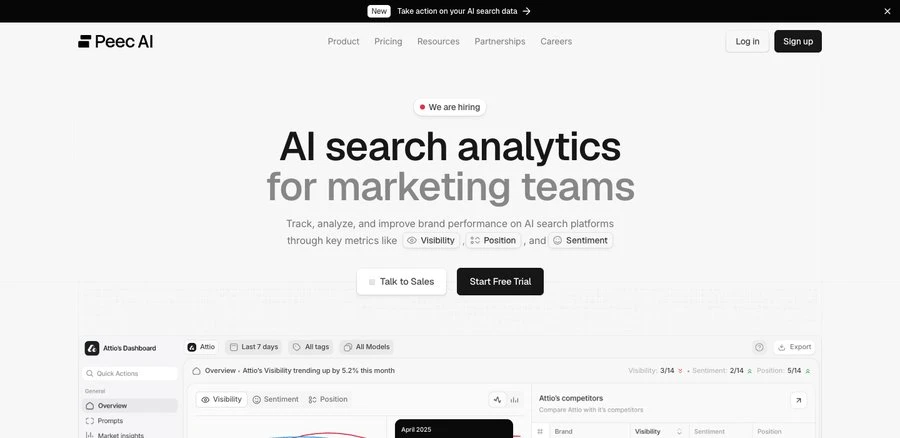
Peec AI is popular with startups and agencies for its clear dashboards and unlimited users on every plan. The Starter plan gives you 50 prompts and lets you choose three models from ChatGPT, AI Mode, AI Overviews, Copilot, Gemini and Naver AI. Two newer features stand out: an ads library that shows AI answers carrying sponsored placements, and fact-checking of what AI says about your brand.
- Price: $95/mo, or $80/mo billed annually.
- Engines: pick 3 on Starter, up to 13 on Enterprise.
- Best for: lean marketing teams and agencies that share reports widely.
- Watch out for: the three-model cap on self-serve plans means you have to choose what to leave out.
7. Otterly.AI: cheapest monthly subscription for four engines
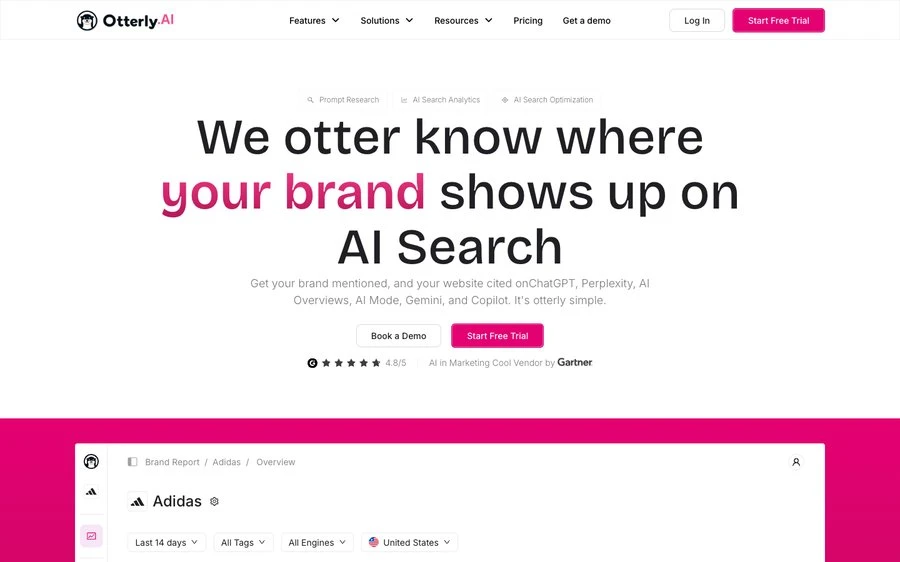
Otterly.AI has the lowest monthly subscription price on this list. The Lite plan is $29 a month and covers ChatGPT, Google AI Overviews, Perplexity and Copilot. It also tracks ChatGPT Ads, which few tools do yet.
- Price: Lite $29/mo ($25 annual), Standard $189/mo, Premium $489/mo.
- Engines: 4 included. Claude, AI Mode and Gemini are paid add-ons.
- Best for: solo founders and small businesses taking their first step into tracking.
- Watch out for: 15 prompts on Lite is tight, and the add-ons push the real price up.
8. ZeroRank: best for broad engine coverage
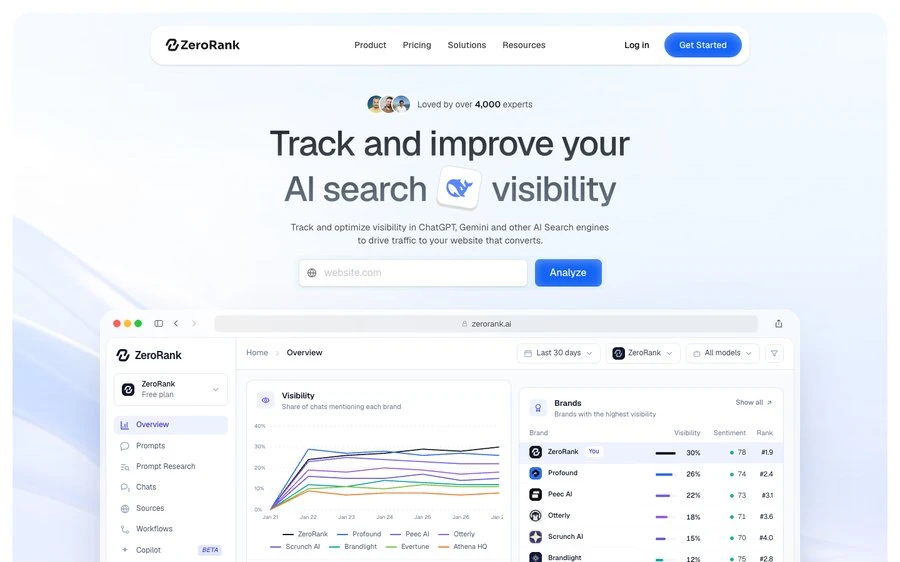
ZeroRank covers 17 AI platforms, including ChatGPT, Perplexity, Gemini, Google AI Overviews, Claude, Copilot, Grok and DeepSeek. Instead of capping prompts, it offers unlimited prompts and models and caps the number of AI answers analysed (up to 2,400 a month on Starter, 13,500 on Growth and 31,500 on Agency). You can run a full report before entering a card.
- Price: Starter $39/mo, Growth $199/mo, Agency $499/mo, with 15% off billed yearly.
- Engines: 17 AI platforms.
- Best for: brands that want to see the long tail of engines, not only ChatGPT and Google.
- Watch out for: because the cap counts answers, the more engines you track, the fewer prompts you can run.
9. SE Visible: best value for prompt volume
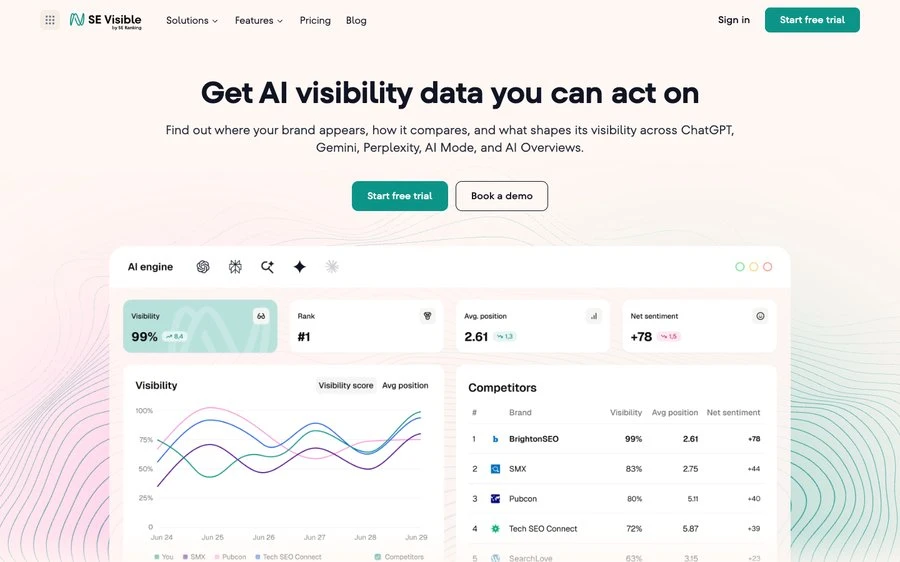
SE Visible is SE Ranking’s standalone AI visibility tool, and it is generous. The Basic plan includes 200 prompts, about 30,000 AI answers a month and three projects. That is eight times the prompts of some rivals at the same $99 price. There is a 10-day free trial.
- Price: Basic $99/mo ($79 annual), Core $189/mo, Plus $355/mo.
- Engines: ChatGPT, Gemini, AI Mode, Perplexity, AI Overviews.
- Best for: agencies and teams that need to track many prompts or several brands.
- Watch out for: no Claude or Copilot coverage yet (Claude is listed as coming).
10. Scrunch: best for brands preparing for AI agents
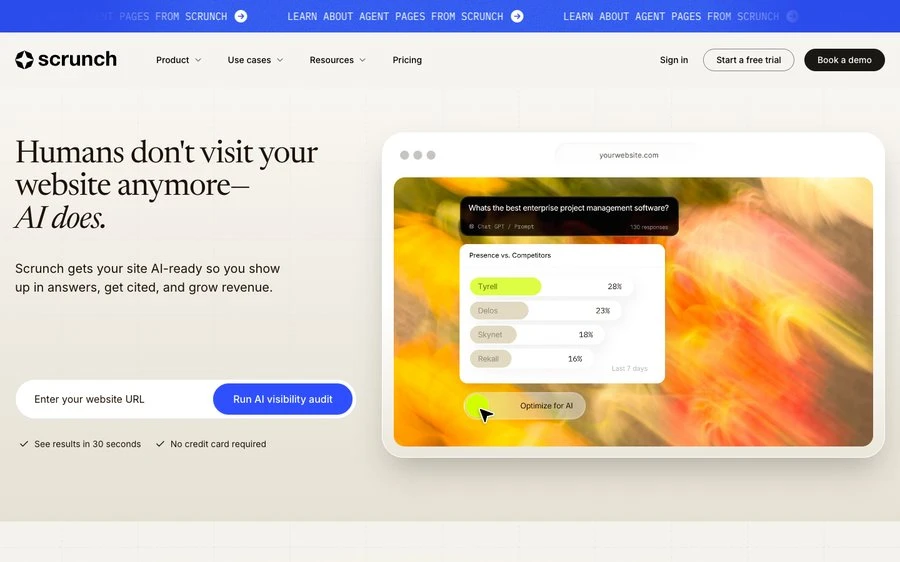
Scrunch, which Sitecore acquired in June 2026, goes beyond tracking. On the Enterprise plan, its Agent Experience Platform (AXP) serves AI-optimised versions of your pages to AI agents and retrieval bots, while search engines and human visitors see your normal site. The Core plan covers tracking: 125 prompts and 5,000 responses a month across ChatGPT, Perplexity, Google AI Overviews and Copilot.
- Price: Core $250/mo, with a 7-day free trial. Enterprise is custom.
- Engines: 4 on Core, 9 on Enterprise.
- Best for: mid-market and enterprise brands, especially on Sitecore.
- Watch out for: the highest entry price on this list, and AXP, the feature that sets Scrunch apart, needs Enterprise.
11. Ahrefs Brand Radar: best for competitive research
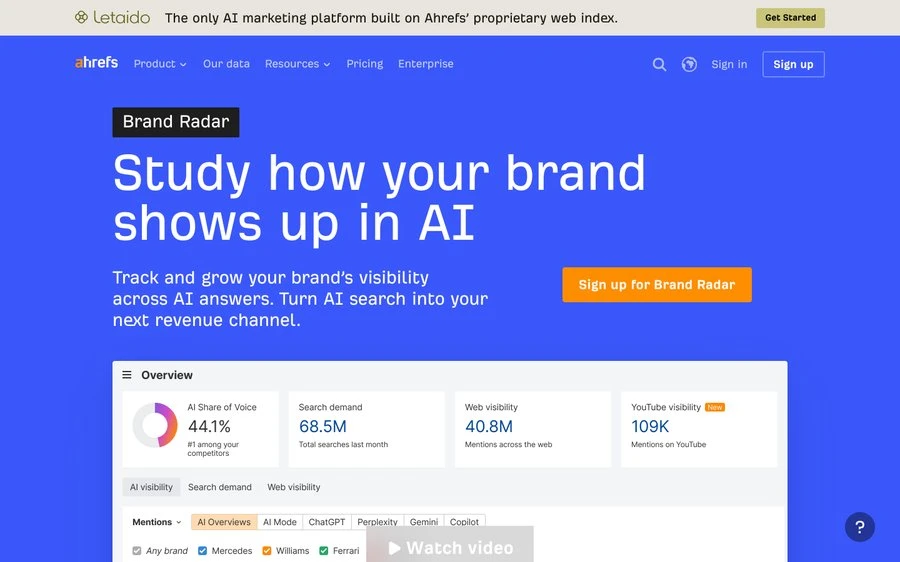
Ahrefs Brand Radar works differently from the rest. Instead of only tracking your own prompts, it runs on a database of more than 490 million prompts, so you can look up any brand’s AI visibility with no setup. That makes it excellent for competitor research and for finding the questions where rivals show up and you do not.
- Price: custom prompts from $50/mo, the AI Visibility Index at $199/mo, or all models for $699/mo. You need a paid Ahrefs plan. Every paid Ahrefs plan already includes a few tracked AI prompts (5 on Lite, 10 on Standard, 20 on Advanced), so existing customers can start without the $50 add-on.
- Engines: Google AI Overviews, AI Mode, Gemini, ChatGPT, Perplexity, Copilot.
- Best for: SEO teams already on Ahrefs who want market-wide AI data.
- Watch out for: full coverage gets expensive fast once you stack it on an Ahrefs subscription.
How to pick the right checker for you
- Just starting out? Run a free readiness check first. Fix crawler access, structured data and basic page structure before you pay for anything.
- Want to see if fixes work? Add a low-cost tracker like Machined.ai, Otterly.AI or HubSpot AEO with 15 to 25 prompts that match real buyer questions.
- Agency or multi-brand? Look at SE Visible or ZeroRank’s Growth and Agency plans.
- Already pay for Semrush or Ahrefs? Start with their AI add-ons so your AI data sits next to your SEO data.
- Enterprise with procurement rules? Shortlist Profound and Scrunch.
One tip that saves a lot of money: choose your prompts before you choose your tool. Write down 15 to 25 questions your buyers really ask, the “best X for Y” and “X vs Y” kind. If a tool cannot track those well within your budget, it is the wrong tool.
What to do after you check: the fundamentals still win
A checker only tells you where you stand. Moving the number comes down to the same work that drives classic SEO, which is why SEO is simpler than it looks. Here is what moves AI visibility for most sites:
- Let the AI crawlers in. Check that robots.txt does not block GPTBot, ClaudeBot, PerplexityBot or Google-Extended. It is the most common reason a good site gets ignored.
- Own whole topics, not single keywords. AI engines lean on sites that cover a subject in depth. Building content clusters around your core topics is the most reliable way to show that.
- Link your pages together. Good internal linking helps crawlers find and understand your content, and it does the same for AI crawlers.
- Avoid competing with yourself. If three pages chase the same question, none of them is the clear answer. Fix keyword cannibalisation before you publish more.
- Back up your claims. AI engines like content with facts they can verify. Cite strong sources, and follow good external linking practice. Tools with built-in research and citations make this much faster at scale.
- Add structured data. Organization, Article and FAQ schema tell engines exactly who you are and what each page covers.
- Get mentioned elsewhere. AI answers lean heavily on third-party sources like reviews, listicles, Reddit threads and industry press. Being described clearly and consistently across the web is what turns a readiness score into real recommendations.
And if you are worried that AI-assisted content will hurt you, it will not by itself. What matters is whether the content is useful, as Machined.ai explains in is AI content bad for SEO.
FAQ
What is an AI visibility checker?
An AI visibility checker is a tool that shows whether AI engines like ChatGPT, Gemini, Perplexity and Google AI Overviews can find, understand and recommend your brand. Some check your website’s readiness, others track live answers to real prompts over time.
How much does AI visibility tracking cost?
Pay-per-check trackers like Machined.ai start at a few dollars a month. Subscription trackers start at $29 a month (Otterly.AI Lite), and most mid-range plans cost $39 to $250 a month. Enterprise tools like Profound use custom pricing.
How many prompts should I track?
Most small and mid-size businesses do well with 15 to 50 prompts that mirror real buyer questions. Agencies and brands in competitive categories often need 100 or more.
Which AI engines matter most?
ChatGPT and Google (AI Overviews and AI Mode) reach the most people, with 900 million weekly ChatGPT users and over 1 billion monthly AI Mode users. Perplexity, Gemini, Claude and Copilot matter more in some B2B and technical audiences.
Do I need GEO if my SEO is strong?
Strong SEO covers most of it. AI engines reward the same things: useful content, authority and a clean technical setup. A checker helps you spot the gaps that are specific to AI, such as blocked AI crawlers or missing structured data.
How often should I check my AI visibility?
Run a readiness check after any major site change. For prompt tracking, look at weekly or monthly trends rather than daily swings, because AI answers vary from run to run.
Final thoughts
AI visibility is not a mystery, and it does not need a whole new playbook. Start with a free readiness check, fix what blocks AI engines from reading you, then track a small set of real buyer prompts to see if it is working. Keep investing in the fundamentals, because that is what both Google and the AI engines reward.